

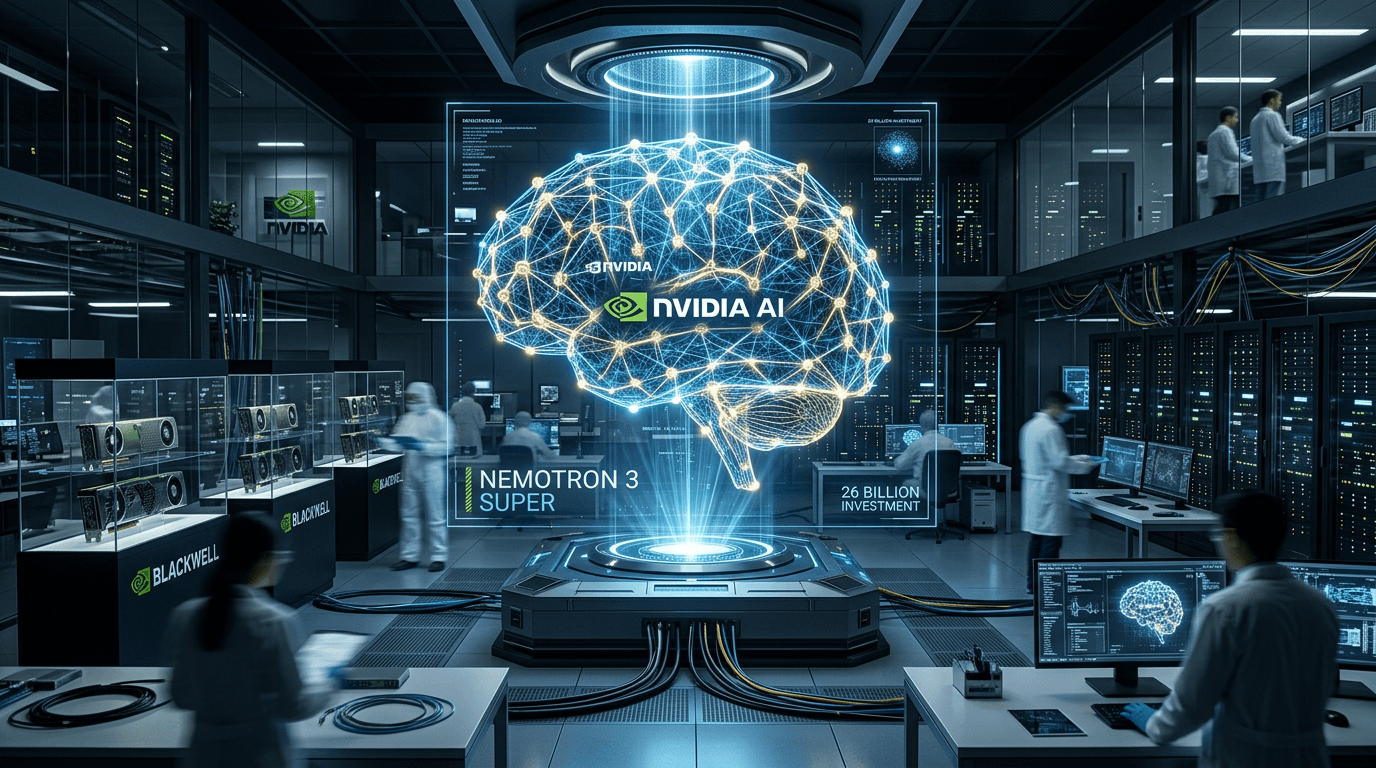
Nvidia's Massive Bet: Reshaping the AI Landscape with $26 Billion
In a seismic shift that has reverberated through Silicon Valley and beyond, Nvidia has formally committed a staggering $26 billion to the development of open-weight AI models and infrastructure. This strategic pivot, revealed in recent corporate filings and analyzed by industry experts, marks a departure from Nvidia's traditional role as the world's leading supplier of AI hardware. By aggressively moving into the model layer, Nvidia is positioning itself to challenge the dominance of closed-source giants like OpenAI and Google, offering a path for enterprises to achieve high-performance AI while maintaining complete control over their proprietary data.
According to reports from Wired, this $26 billion investment is not merely about research and development; it is an effort to build a comprehensive ecosystem around open-weight models. For years, the industry's most advanced intelligence has been locked behind the proprietary APIs of a few firms. Nvidia’s decision to champion open weights—where the trained parameters of a model are released publicly while the training data might remain private—is a direct response to the growing demand for "Sovereign AI." This trend sees nations and corporations seeking to host and run their own advanced models on their own hardware, free from the constraints and privacy concerns of shared cloud endpoints.
Technical Marvel: The Launch of Nemotron 3 Super
At the heart of this new strategy is the release of Nemotron 3 Super, a 120-billion-parameter model that pushes the boundaries of hybrid AI architecture. Unlike traditional models that rely solely on the Transformer architecture, Nemotron 3 Super integrates State-Space Models (SSM) and other disparate neural philosophies. As reported by VentureBeat, this hybrid approach allows the model to handle "long-horizon tasks"—such as complex software engineering, cybersecurity triaging, and multi-agent coordination—with unprecedented efficiency.
One of the most critical challenges in the modern enterprise AI stack is the cost of token throughput. Multi-agent systems, where several AI bots work together to solve a problem, can generate up to 15 times more token volume than standard chat interfaces. Nemotron 3 Super is specifically engineered to solve this cost-effectiveness problem. By merging SSMs with Transformers, the model achieves significantly higher throughput and lower latency for long-context tasks, effectively beating leading open-source rivals like Qwen and gpt-oss in initial benchmarks. The model weights have already been posted on Hugging Face, signaling Nvidia's commitment to the open-source community.
Market Analysis: Global Trends and the Taiwan Connection
Nvidia’s technological leap is being watched with intense interest in major tech hubs. Data from Google Trends as of March 12, 2026, indicates a sustained high interest in "AI" topics, particularly in Taiwan, where the interest score remains at 70. This is no surprise given Taiwan's role as the manufacturing epicenter for Nvidia's Blackwell GPUs. The industry in Taiwan views Nvidia's move into software and models as a dual-edged sword: while it solidifies the demand for high-end silicon, it also introduces a new layer of software optimization that requires deeper integration with Taiwanese hardware partners.
Financial analysts suggest that Nvidia's $26 billion roadmap is a preemptive strike against potential market saturation. By making high-performance models available for free (in terms of licensing), Nvidia ensures that the demand for the specialized chips required to run these models remains robust. This strategy mimics the "razor and blades" model, where the intelligence is the facilitator for the underlying high-margin hardware. However, with a $26 billion price tag, the stakes are higher than ever, and investors will be looking for clear evidence that this software investment leads to direct hardware upsell cycles in late 2026.
The Legal and Geopolitical Implications of Sovereign AI
Nvidia's shift also carries significant weight in the realm of global policy and regulation. As governments worldwide grapple with the ethics and safety of AI, the "black box" nature of proprietary models has become a point of contention. By providing open-weight models, Nvidia aligns itself with the growing movement for transparency and local control. This "Sovereign AI" approach is particularly attractive to European and Asian regulators who are wary of relying on a handful of US-based closed-source providers for critical national infrastructure.
However, the path is not without regulatory hurdles. Ars Technica reports that Nvidia is also planning a competitor to the popular OpenClaw tool, tentatively named NemoClaw. This move into autonomous agent software could invite antitrust scrutiny, as Nvidia already controls the dominant hardware platform. Critics argue that by bundling optimized models with their hardware, Nvidia may be creating a "walled garden" that, while open-source in name, is practically inseparable from Nvidia’s proprietary CUDA software stack.
Future Outlook: A New Era of AI Competition
The launch of Nemotron 3 Super and the $26 billion investment commitment signal the beginning of a new chapter in the AI wars. We are moving away from a world of "one model fits all" and toward a landscape of highly specialized, hybrid architectures that can be deployed on-premises. For the enterprise sector, this means a significant reduction in the barriers to entry for deploying complex, multi-agent AI systems.
Looking ahead, the success of Nvidia's gamble will depend on the adoption rate among developers and the ability of the open-source community to build upon Nemotron 3 Super. If Nvidia can successfully foster an ecosystem where the best enterprise models are those optimized for its own hardware, it will have secured its dominance for the next decade. For now, the tech world watches as the world’s most valuable chipmaker attempts to rewrite the rules of the AI software industry.