

A New Milestone in Collaborative AI: Google vs. OpenAI
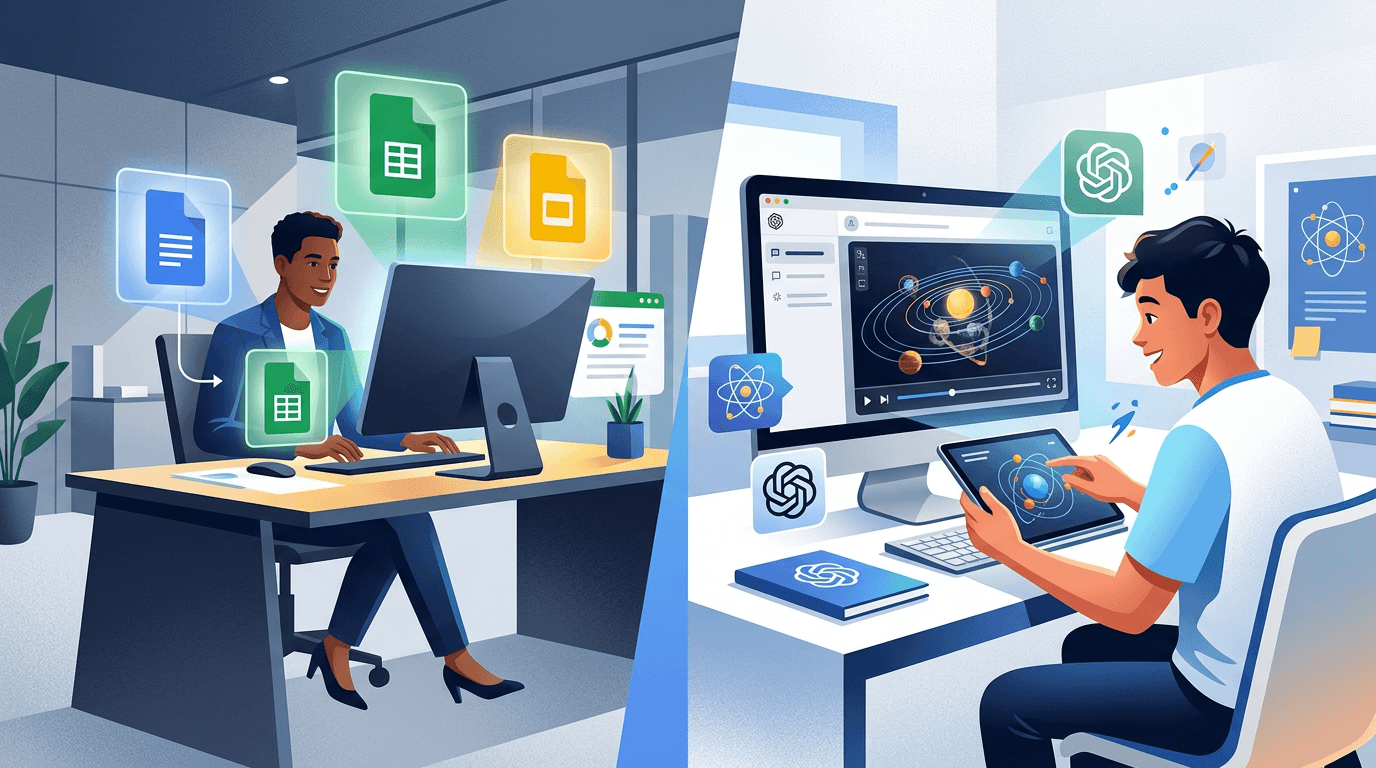
On March 10, 2026, the AI productivity market reached a pivotal turning point as Google and OpenAI simultaneously unveiled major upgrades to their respective ecosystems. These updates aim to transform generative AI from simple chatbots into comprehensive workflow assistants. Google announced an upgraded Gemini for Workspace, capable of cross-app data synthesis across Docs, Sheets, and Drive, while OpenAI introduced interactive visualization tools for ChatGPT, revolutionizing how complex mathematical and scientific concepts are understood.
Google Gemini's Deep Integration: Breaking the Silos
According to VentureBeat, the latest version of Gemini for Workspace allows users to command the AI to reference multiple PDFs in Drive, data points in Sheets, and context from Gmail to generate a cohesive project proposal or presentation. This addresses a long-standing pain point: the AI's inability to 'remember' context across different applications. Google claims this integration will drastically reduce context-switching time, enabling true cross-platform automation for enterprise users.
OpenAI's Countermove: Interactive Visuals for Math and Science
While Google focused on office workflows, OpenAI targeted education and professional analysis. As reported by TechCrunch, ChatGPT can now create interactive visualizations, allowing users to manipulate mathematical formulas or scientific models directly within the chat interface. For instance, a student can adjust parameters in a physics equation and see the resulting graph update in real-time. This multimodal interactivity shifts ChatGPT from a static text generator to a dynamic 'interactive lab,' a move highly praised by engineers and educators.
Balancing Innovation and User Control: The Google Photos Toggle
In response to user feedback regarding AI intrusiveness, Google has also introduced a feature for Google Photos that allows users to toggle between the AI-powered 'Ask Photos' search and a 'fast classic search.' This move suggests that tech giants are beginning to recognize the importance of user agency and the need to balance aggressive AI rollouts with traditional, reliable user experiences. Verified reports indicate this change follows significant user complaints about the complexity of the initial AI search implementation.
Market Analysis: The Shift to Ecosystem Wars
Analysts believe these updates represent the second phase of the AI war: ecosystem integration. Model performance alone is no longer the primary differentiator; success now depends on how seamlessly AI can be embedded into existing daily tasks. Google's strength lies in its massive Workspace moats, while OpenAI continues to win over developers and specialists through rapid innovation in interactive capabilities. These developments signal that AI is moving toward becoming the central nervous system of modern computing.
Future Outlook: The Path to Autonomous Agents
Gemini's new ability to pull data from multiple sources is a clear precursor to fully autonomous AI agents. Soon, these assistants will not just help draft emails but will autonomously analyze reports, check schedules, and execute tasks based on historical context. The ongoing battle between Google and OpenAI is essentially a race to redefine the very nature of software, moving from tools humans use to agents that work on behalf of humans.