

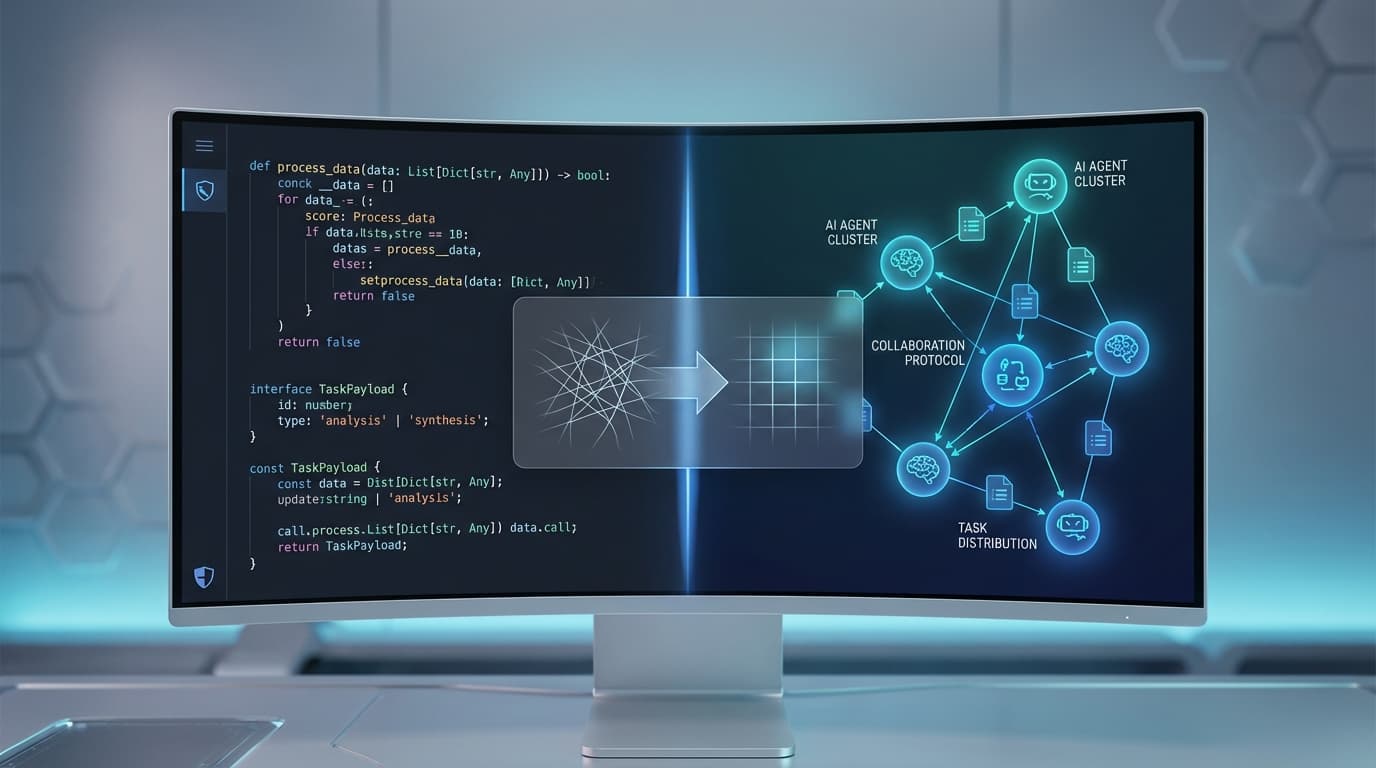
2025 AI Agent Framework Revolution: From Experimental Loops to Structured Engineering
The AI agent landscape in 2025 has undergone a fundamental paradigm shift. Moving away from the "experimental loops" and prompt-heavy trial-and-error of previous years, the industry has embraced structured orchestration, type safety, and spec-driven development. This evolution marks the transition of AI development from a niche "alchemy" to a disciplined branch of software engineering.
The Rise of Production-Ready SDKs
In early 2025, tech giants redefined the baseline for agent development. The OpenAI Agents SDK, released in March, officially succeeded the "Swarm" experiment. It prioritizes minimal abstractions and seamless "handoffs" between specialized agents. Its native support for the Model Context Protocol (MCP) allows developers to build interconnected agent ecosystems with unprecedented ease.
Simultaneously, Google introduced the Agent Development Kit (ADK). Taking a "code-first" approach, the ADK treats agentic workflows like traditional software modules. It offers deterministic controls that mitigate the unpredictability of LLMs, making it a favorite for enterprise-scale deployments on Vertex AI.
Engineering Rigor: Spec-Driven and Type-Safe
A significant trend in 2025 is the rejection of "vibe-coding"—developing based on intuition rather than structure. GitHub Spec Kit has pioneered Spec-Driven Development (SDD), where a project's "Constitution" and technical plan serve as the source of truth. This ensures that AI coding agents like Claude Code or Copilot adhere to architectural principles rather than drifting into technical debt.
For Python enthusiasts, Pydantic AI has emerged as the "FastAPI for Agents." By leveraging Pydantic V2 for strict output validation and dependency injection, it allows developers to write unit-testable agent logic. This focus on data integrity is crucial for applications where hallucinations could lead to significant business risks.
The Ecosystem Diversifies: TypeScript and Multimodal Teams
The TypeScript community found its standard in Mastra. Built by the creators of Gatsby, Mastra provides a "batteries-included" experience for full-stack developers, integrating RAG workflows and automated evaluations into a cohesive TS-native environment.
On the other hand, Agno (formerly Phidata) has carved a niche in "Reasoning Agents." By focusing on multi-agent teams that can handle multimodal inputs and maintain long-term knowledge, Agno is ideal for data-heavy research and analysis tasks that require specialized tool use.
Conclusion
The frameworks of 2025 share a common goal: making AI agents reliable, maintainable, and scalable. As abstractions become thinner and type safety becomes the norm, the barrier between "AI development" and "standard software engineering" continues to blur. The future belongs to frameworks that empower developers to build agents that are not just smart, but predictable.