

A New Journey Beyond Meta
Turing Prize winner and former Meta Chief AI Scientist Yann LeCun has made a thunderous re-entry into the startup world. On March 9, 2026, his new venture, AMI Labs, announced it had raised $1.03 billion in a seed round at a $3.5 billion pre-money valuation. This massive injection of capital, led by top-tier venture firms, signals a significant paradigm shift in the AI industry: moving from "language modeling" to "world modeling."
The Limits of LLMs and the Absence of Physical Common Sense
LeCun has long been a vocal critic of current autoregressive Large Language Models (LLMs). He argues that approximately 90% of human knowledge is derived from observing and interacting with the physical world, not through language. While today's AI can write fluid text, it often lacks basic common sense about physical reality—such as knowing that an object will fall when released or accurately predicting the trajectory of a moving object under force.
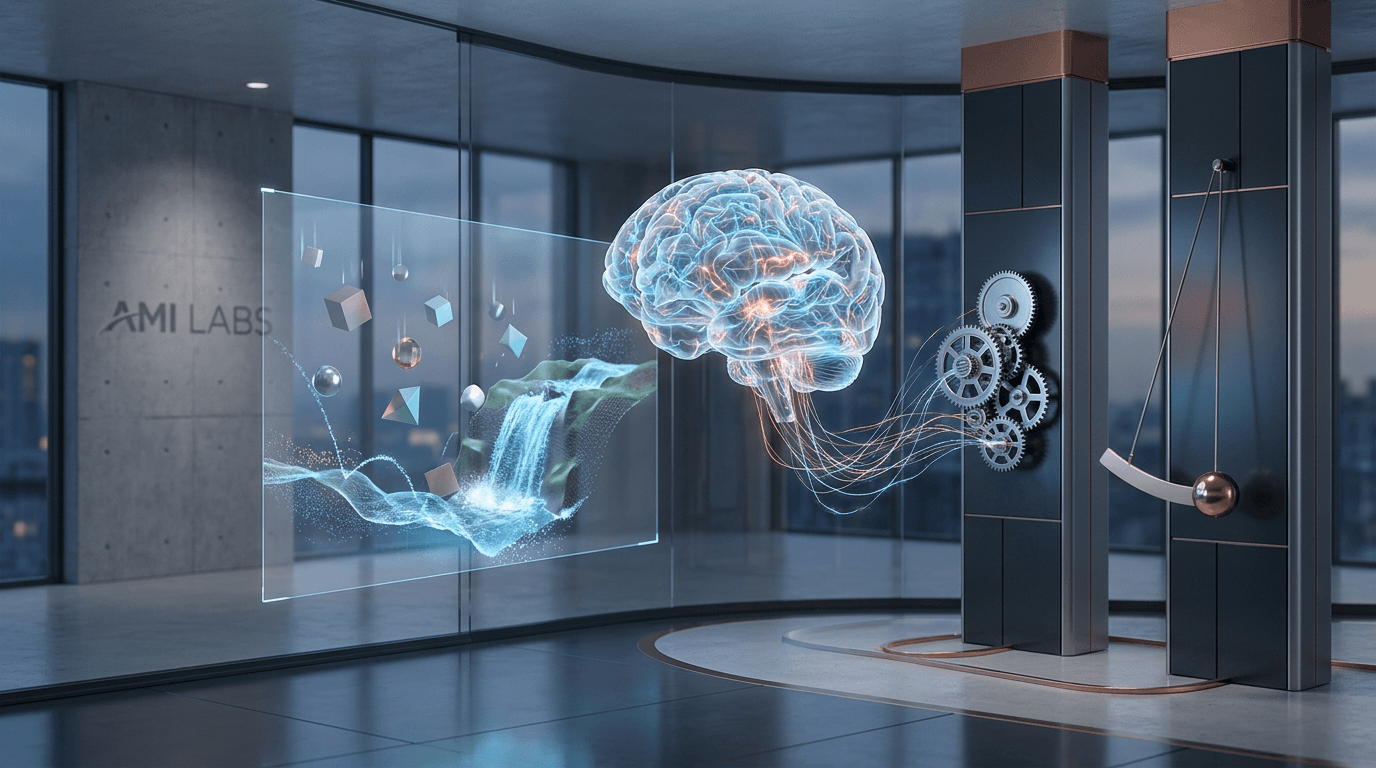
AMI Labs' core mission is the development of "World Models." As reported by Wired, LeCun believes that human-level AI must master the laws of physics. Unlike ChatGPT, which predicts the next token in a sequence, AMI’s models will utilize his "Joint-Embedding Predictive Architecture" (JEPA), designed to help AI learn causal relationships and physical constraints similarly to biological organisms.
Strategic Layout: Compute Power and Algorithmic Moats
To support the immense computational requirements of training such models, AMI Labs has inked a massive compute deal with Nvidia. TechCrunch reports that the agreement involves at least one gigawatt (GW) of compute power and includes a strategic investment from Nvidia. This partnership suggests that hardware giants are placing large bets on the future of "Physical AI." Simultaneously, Thinking Machines Lab has entered into a similar agreement with Nvidia, indicating that the next competitive frontier for AI will be the ability to simulate and understand the real world.
Scientific Evidence: The Case for World Models
Recent research published on arXiv (arXiv:2603.08706) demonstrates that agents trained solely on imitation learning often lack an awareness of action quality because they do not understand "why" a certain action is taken. World models address this by allowing AI to understand the physical consequences of different behaviors through contrastive learning. LeCun’s JEPA architecture has been academically validated as more efficient at processing non-linguistic data than traditional models. Scientific literature suggests this approach could significantly reduce AI "hallucinations" by grounding models in physical facts rather than just statistical probabilities.
Market Trends: A Shift in AI Investment
Google Trends data indicates that search interest for "World Models" and "JEPA" has increased by 300% over the past week. Investors are beginning to realize that the battle over parameter-heavy language models has reached a point of diminishing returns. Technology that enables AI to possess "physical operational capabilities" is seen as the true key to reaching Artificial General Intelligence (AGI). This trend is already bleeding into the robotics industry, where physical cognition is the primary bottleneck.
Conclusion: The Next Decade of AI
Yann LeCun’s $1 billion funding is more than just a business headline; it represents a fundamental rethinking of AI's future path. If AMI Labs succeeds in developing mature world models, AI will evolve from a digital assistant on a screen to an intelligent entity capable of understanding and manipulating the physical world with precision. We are witnessing AI’s transition from a "liberal arts student" to a "scientist."