

A Landmark in Capital: The Pinnacle of AI Funding
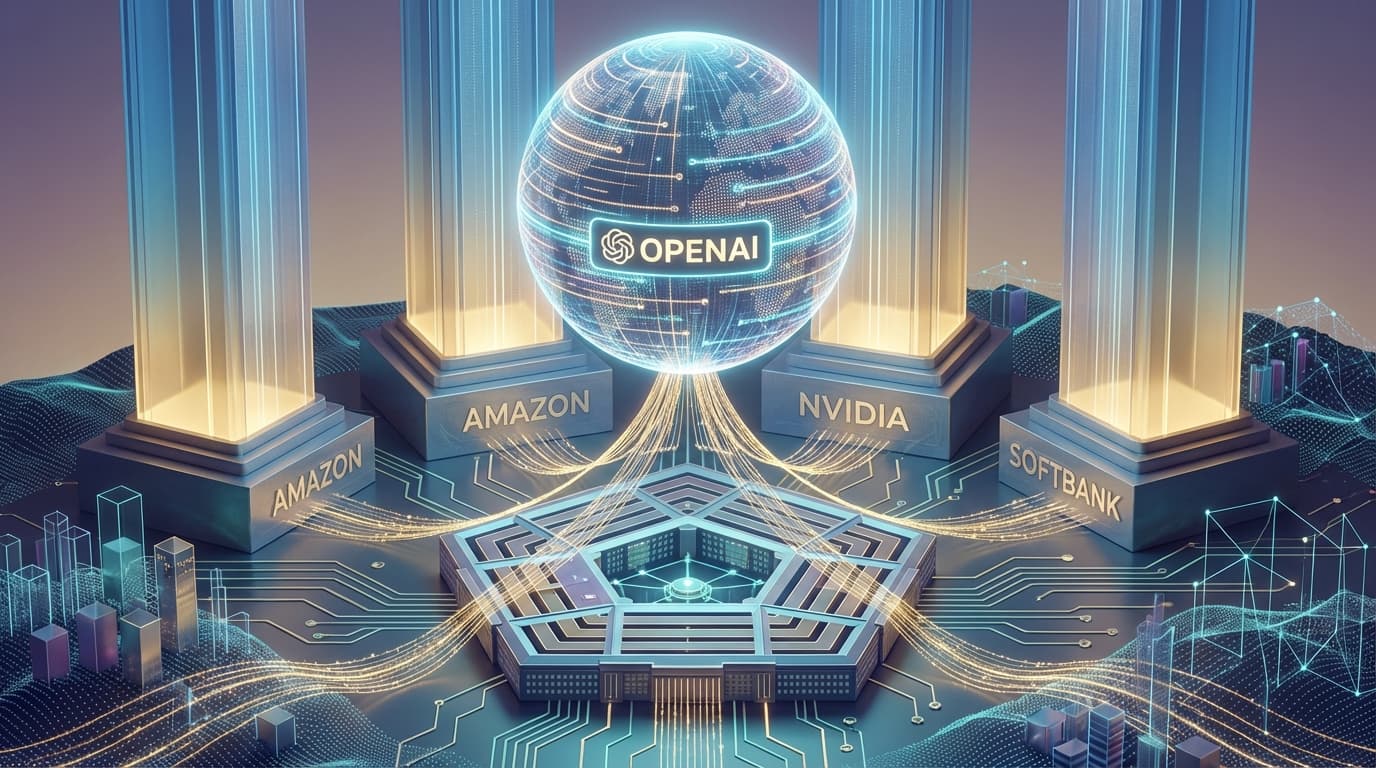
In a week defined by regulatory turmoil for some, OpenAI has secured a dominant future. The company officially announced a historic $110 billion funding round from a triumvirate of technology titans. Amazon led the charge with a staggering $50 billion investment, while Nvidia and SoftBank contributed $30 billion each. This is not only the largest single funding event in AI history but a definitive consolidation of power within the industry.
As reported by VentureBeat (2026), the deal extends far beyond capital. OpenAI and Amazon Web Services (AWS) are collaborating to build a new 'Stateful Runtime Environment.' This architecture allows enterprise-grade AI agents to maintain memory and context across long-duration workflows, solving one of the primary hurdles for deploying autonomous agents in corporate environments.
The Pentagon Partnership: Navigating the Ethical Maze
In stark contrast to Anthropic’s blacklisting, OpenAI CEO Sam Altman announced a new strategic contract with the Department of Defense. Altman claimed the deal includes 'technical safeguards' designed to ensure that AI remains under human oversight and adheres to safety protocols. According to TechCrunch (2026), these safeguards are the 'missing link' that allowed OpenAI to bypass the ideological friction that derailed Anthropic’s negotiations.
By securing this deal, OpenAI positions itself as the primary AI architect for the US government. The partnership likely involves deploying specialized models within AWS GovCloud regions to meet rigorous IL5/IL6 security standards for classified and mission-critical data. This move effectively integrates OpenAI into the heart of the national security infrastructure.
Growth Metrics: 900 Million Weekly Active Users
Parallel to its institutional victories, OpenAI’s consumer reach has hit a massive milestone: ChatGPT now boasts 900 million weekly active users. This scale provides a feedback loop that is unrivaled in the sector, offering OpenAI an insurmountable lead in data and refinement capability. For investors like SoftBank’s Masayoshi Son and Nvidia’s Jensen Huang, these metrics justify the astronomical valuation of the round.
However, the $30 billion stake from SoftBank may trigger scrutiny from the Committee on Foreign Investment in the United States (CFIUS). Given OpenAI’s status as a 'dual-use' technology provider with sensitive defense contracts, any significant foreign influence will be examined for potential national security risks.
The Road to AGI: Stateful Agents and Sovereign Infrastructure
The most critical takeaway from this deal is the shift toward 'stateful' AI. Moving away from ephemeral, session-based interactions, the next generation of OpenAI models will function as persistent digital employees. Supported by Amazon's cloud infrastructure and Nvidia's hardware, OpenAI is no longer just a software provider; it is becoming the foundational layer for the global digital economy and the primary engine of sovereign AI capabilities for the United States.