
A Milestone for AI Infrastructure: The AgentPerf Benchmark
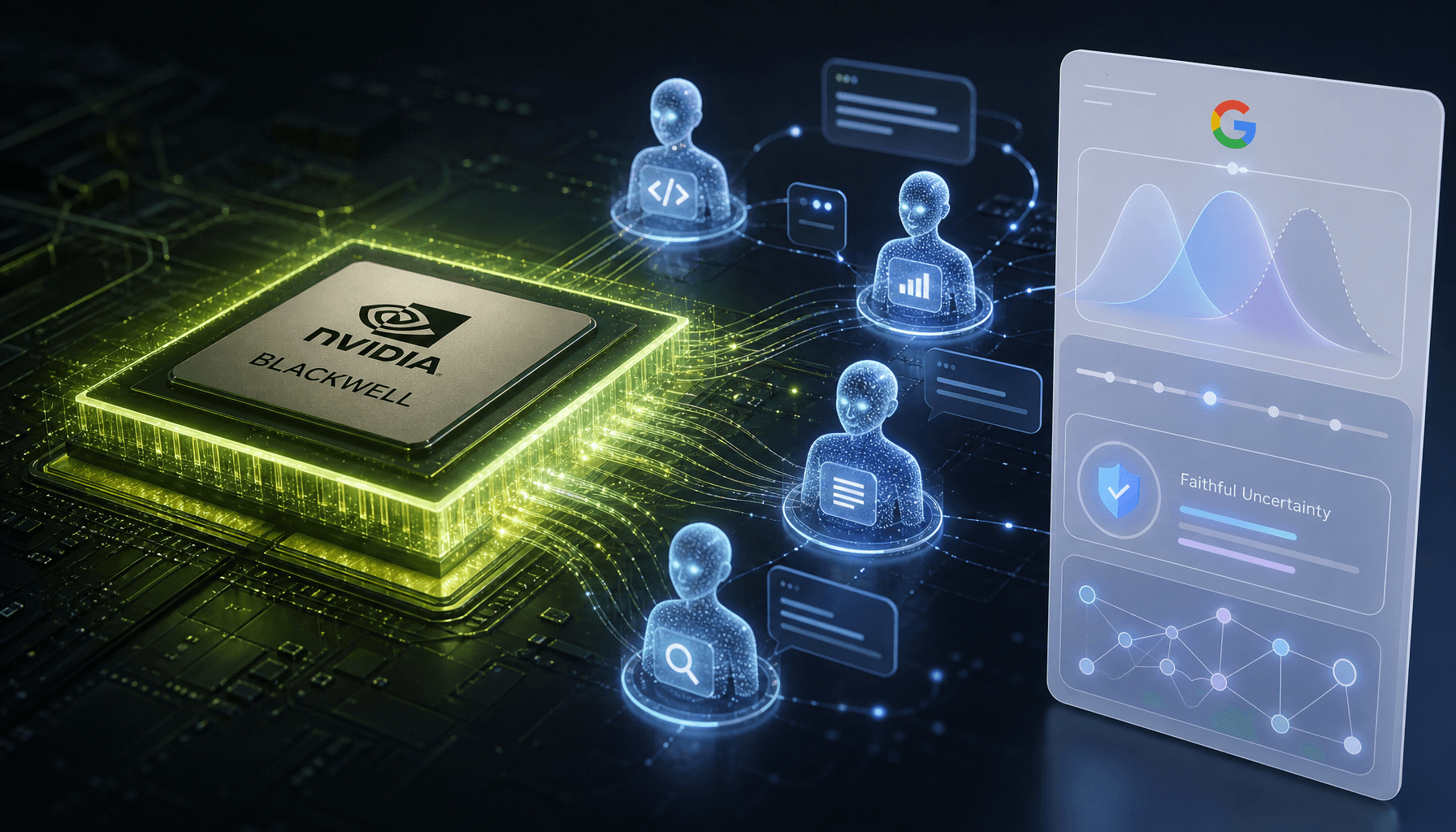
As artificial intelligence shifts from simple language models to "Agentic AI" capable of autonomously executing tasks, the benchmarks for hardware performance are also evolving. NVIDIA recently announced that its latest Blackwell Ultra NVL72 platform has demonstrated exceptional performance in "AgentPerf," the industry’s first benchmark for agentic AI. According to NVIDIA, the platform handles 20x more agents per megawatt compared to previous systems. This data not only demonstrates the Blackwell architecture’s advantage in managing complex task flows but also provides a clear reference for enterprises selecting AI infrastructure.
The Rise of Agentic AI
The core of agentic AI lies in its autonomy and decision-making capabilities, which demand different computing power compared to traditional LLM inference. AgentPerf, developed by Artificial Analysis, aims to simulate scenarios where AI agents execute multi-step tasks in enterprise environments. NVIDIA’s performance validates its advantages in large-scale parallel processing and memory bandwidth, positioning it as the infrastructure of choice for deploying agentic AI. According to Google Trends data, search interest for "Agentic AI infrastructure" reached 82 in major tech hubs.
Google’s New Weapon Against Hallucinations: 'Faithful Uncertainty'
Simultaneous to hardware breakthroughs, reliability in AI software has seen significant progress. Google’s research team has introduced a technique called "Faithful Uncertainty," aimed at addressing the "hallucination" problem in large language models. The technique focuses on aligning the model’s response accuracy with its internal confidence levels. When the model feels "uncertain," it opts to provide its best guess rather than fabricating information, significantly reducing error rates.
Technical Deep Dive
The "Faithful Uncertainty" technique utilizes metacognition to allow AI to monitor its own confidence levels during content generation. When confidence falls below a set threshold, the model takes a more rigorous reasoning path or acknowledges uncertainty to the user. This is revolutionary for fields like medical diagnosis, legal analysis, and financial consulting, where accuracy is paramount. Technical papers on ArXiv show that the technique successfully reduced hallucination rates and improved output consistency across multiple benchmarks.
Industry and Market Impact
The advancements from NVIDIA and Google, in terms of hardware computing power and software reliability, respectively, are accelerating the enterprise adoption of AI. Enterprises no longer need to hesitate about deploying agentic AI due to hallucination concerns, while the Blackwell architecture significantly reduces the cost of large-scale agent deployment. Analysts believe the combination of these technologies will drive AI agents into large-scale commercial use by the end of 2026.
Outlook
With the maturation of benchmarks and hallucination-suppression techniques, AI agents are evolving from "chat tools" into true "digital employees." The focus moving forward will be on how these technologies integrate into existing enterprise workflows and whether they can further lower hardware barriers, allowing small and medium-sized enterprises to benefit from the dividends of agentic AI.