

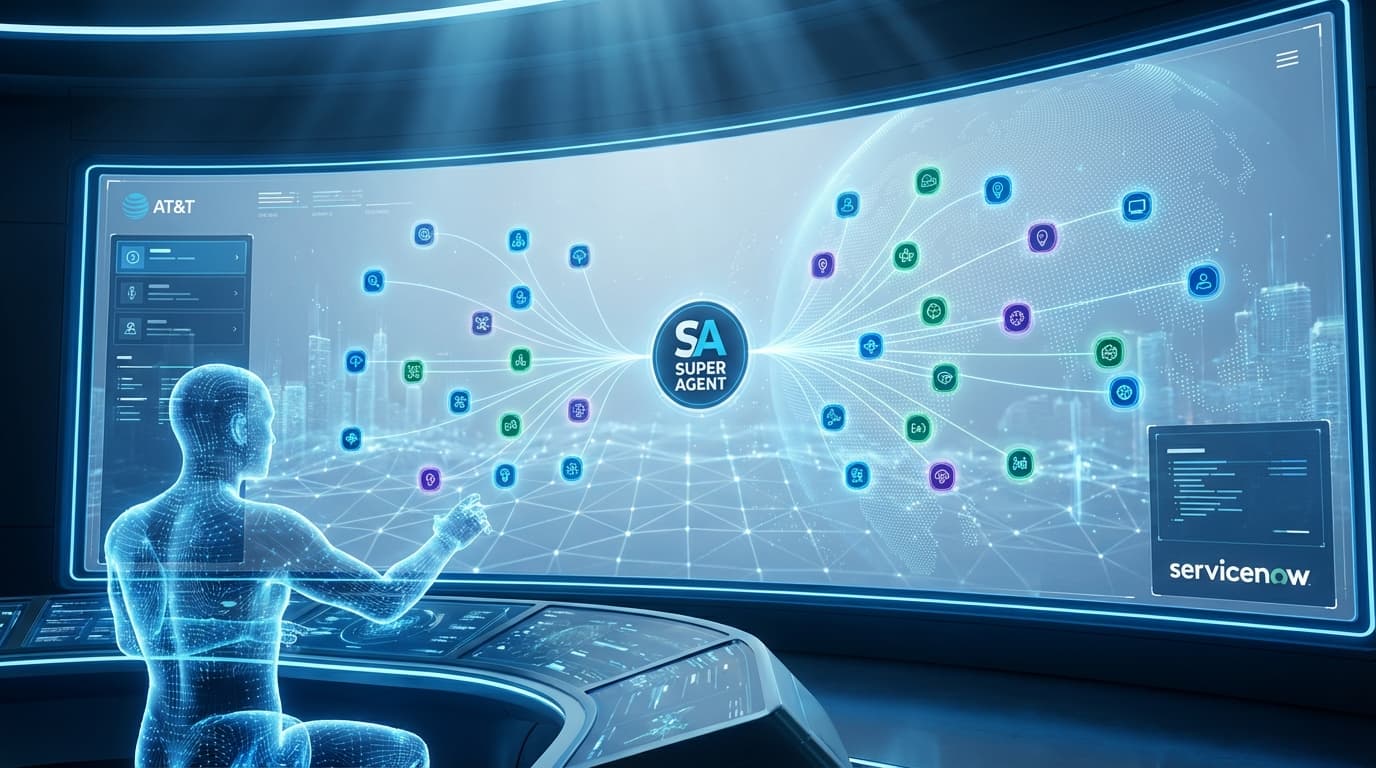
The Rise of Agentic AI: How AT&T and ServiceNow are Redefining Enterprise Orchestration
2026 is recognized as the pivotal year when enterprise AI moved from "experimental pilots" to "mass-scale automation." Led by telecommunications giant AT&T’s 90% cost reduction and ServiceNow’s autonomous handling of 90% of IT requests, an architectural revolution centered on "Orchestration Layers" and "Agentic AI" is sweeping through the global corporate landscape.
From Models to Orchestration: AT&T’s 90% Savings Formula
For a company like AT&T, which processes over 8 billion tokens daily, relying solely on expensive large-scale reasoning models (like GPT-4 or Gemini Pro) became economically unsustainable. According to VentureBeat (2026), Chief Data Officer Andy Markus and his team re-engineered their AI orchestration layer to solve this scale problem.
By implementing a multi-agent stack built on LangChain, AT&T utilizes "Super Agents" to direct smaller, specialized language models for specific tasks. This hierarchical approach maintains response quality while slashing operational costs by 90%, proving that at enterprise scale, success is defined by orchestration finesse rather than model size.
ServiceNow: Accelerating IT Services by 99%
Meanwhile, ServiceNow is redefining internal service standards. The company announced it now resolves 90% of its own employee IT requests autonomously, completing cases 99% faster than human agents.
As reported by VentureBeat (2026), ServiceNow’s breakthrough lies in bridging the gap between "identifying a problem" and "executing a fix." While older AI pilots often stalled at the execution phase due to trust or permission barriers, ServiceNow’s new framework allows AI agents to act autonomously to finish the job. The company now aims to export this technology to its global client base, making agentic AI a standard business requirement.
The Open Source Edge: Alibaba’s Qwen3.5 Challenges Local AI Performance
In the realm of local deployment, Alibaba’s Qwen team has made a significant impact with the release of Qwen3.5-Medium. These models deliver performance comparable to Claude 3.5 Sonnet while running on local hardware.
Per VentureBeat (2026), the 35B and 122B parameter models support sophisticated agentic tool calling and are released under the Apache 2.0 license. This empowers enterprises and independent developers to deploy highly capable, action-oriented AI in secure, private environments at a fraction of the cost of cloud-based APIs.
Market Insight: Surging Interest in Agentic AI
Google Trends data reveals a dramatic spike in searches for "Agentic AI" across both Taiwan and California. In Taiwan, the interest level reflects a strong demand for AI solutions that go beyond simple text generation and into the realm of task execution.
Trending queries often link Agentic AI with "Workflow Automation" and "AI Orchestration." Industry analysts suggest that in 2026, the value proposition has shifted from "providing information" to "delivering outcomes."
The Future Shift: "Decision-Making" as the New Tech Skill
As AI agents take over the grunt work of coding and IT maintenance, the role of human workers is evolving. A report from Wired (2026) suggests that in Silicon Valley, the most valuable skill is no longer technical execution, but the ability to decide what the agents should do. The emergence of "Agentic Individuals" is reshaping talent recruitment and organizational structures worldwide.