

The Shift Toward Edge AI Ubiquity
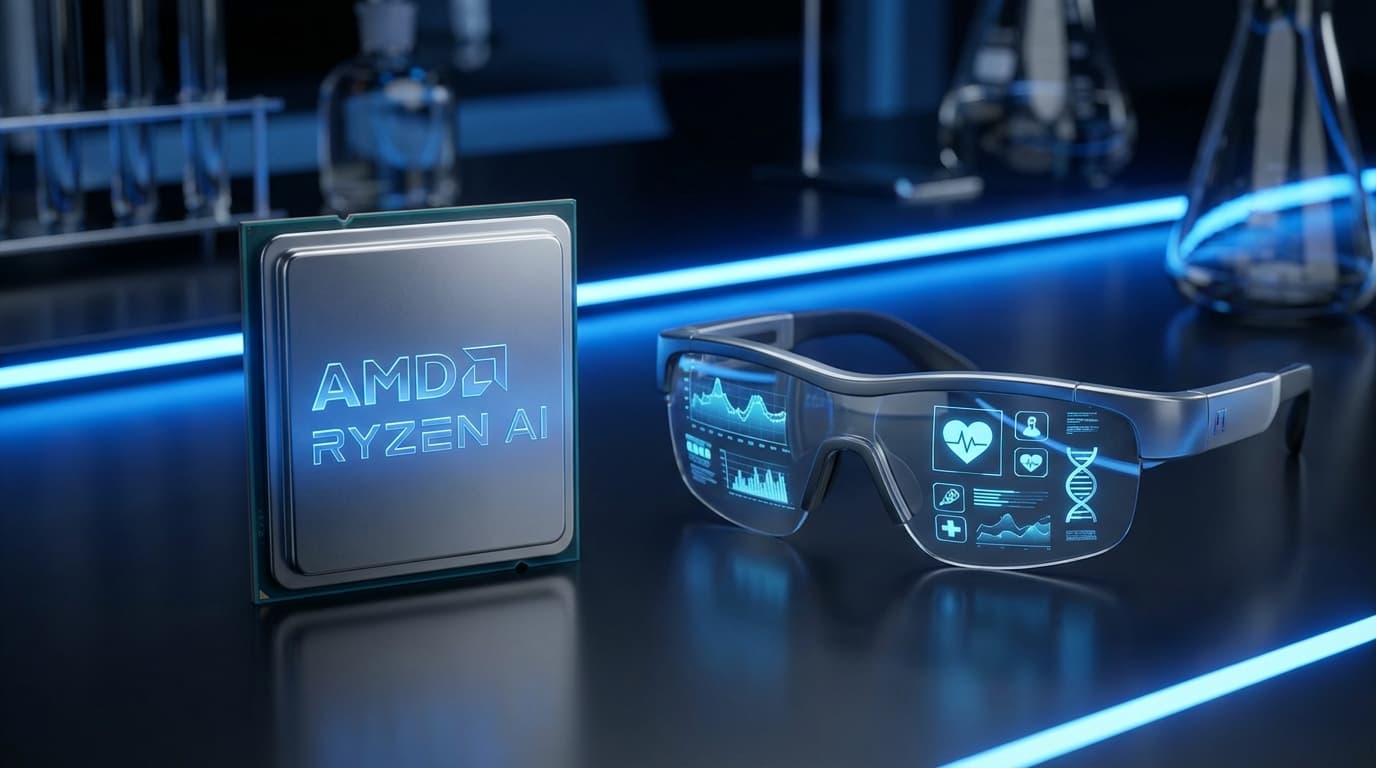
The narrative of artificial intelligence is rapidly moving from massive data centers to the hardware we touch every day. In early March 2026, semiconductor leaders AMD and Qualcomm announced strategic expansions that bring high-performance AI processing to standard desktops and a new class of wearable devices. These developments underscore a future where AI isn't just a cloud service, but a local capability embedded in the very silicon of our primary computing and personal devices.
AMD Ryzen AI 400: Local NPU Processing for the Masses
For the first time, AMD is bringing its specialized AI acceleration to standard desktop PCs. As reported by Ars Technica (2026), the new Ryzen AI 400 series CPUs are designed for the Socket AM5 platform. While previous iterations focused on high-end laptops, this desktop debut marks a commitment to making Neural Processing Units (NPUs) a standard feature of business and productivity PCs. Powered by the XDNA 2 architecture, these chips enable tasks like real-time AI image enhancement and local LLM execution without taxing the GPU or CPU, significantly improving energy efficiency for AI-heavy workflows.
Qualcomm Snapdragon Wear Elite: Powering the 'Wrist Plus' Era
Qualcomm is redefining the wearable segment with the launch of the Snapdragon Wear Elite. During a press briefing covered by The Verge (2026), the company described the Elite as a "wrist plus" chip. This designation indicates that the silicon is intended for more than just smartwatches, extending to AR glasses and integrated biometric devices. The Elite chip is not a simple upgrade to the W5 Plus but a premium tier designed specifically for low-power AI inferencing. This allows for proactive health monitoring and sophisticated voice-assistant capabilities that function locally, reducing latency and enhancing privacy.
Market Sentiment and Google Trends Data
Data from Google Trends indicates a strong surge in interest for "NPU performance" and "Desktop AI CPU," with interest scores hitting 90 in key technical hubs like California and Taipei. The term "AI Wearables" has seen a 180% increase in search volume globally over the past month. This trend reflects a growing consumer appetite for "Private AI," where data processing occurs on the device rather than the cloud. Industry analysts predict that by the end of 2026, NPU performance will be as critical a buying metric for consumers as core counts or clock speeds were in the previous decade.
Outlook: Silicon as the Enabler of Agency
The expansion of AMD and Qualcomm into these segments confirms that the "AI PC" and "AI Wearable" trends are no longer just marketing buzzwords. By providing the hardware foundations for local AI execution, these companies are enabling a new era of software that can run autonomously and privately. As developers begin to optimize applications for the XDNA 2 and Wear Elite architectures, the gap between cloud-based AI and local performance will continue to narrow, ushering in a world where our devices are as intelligent as they are portable.