

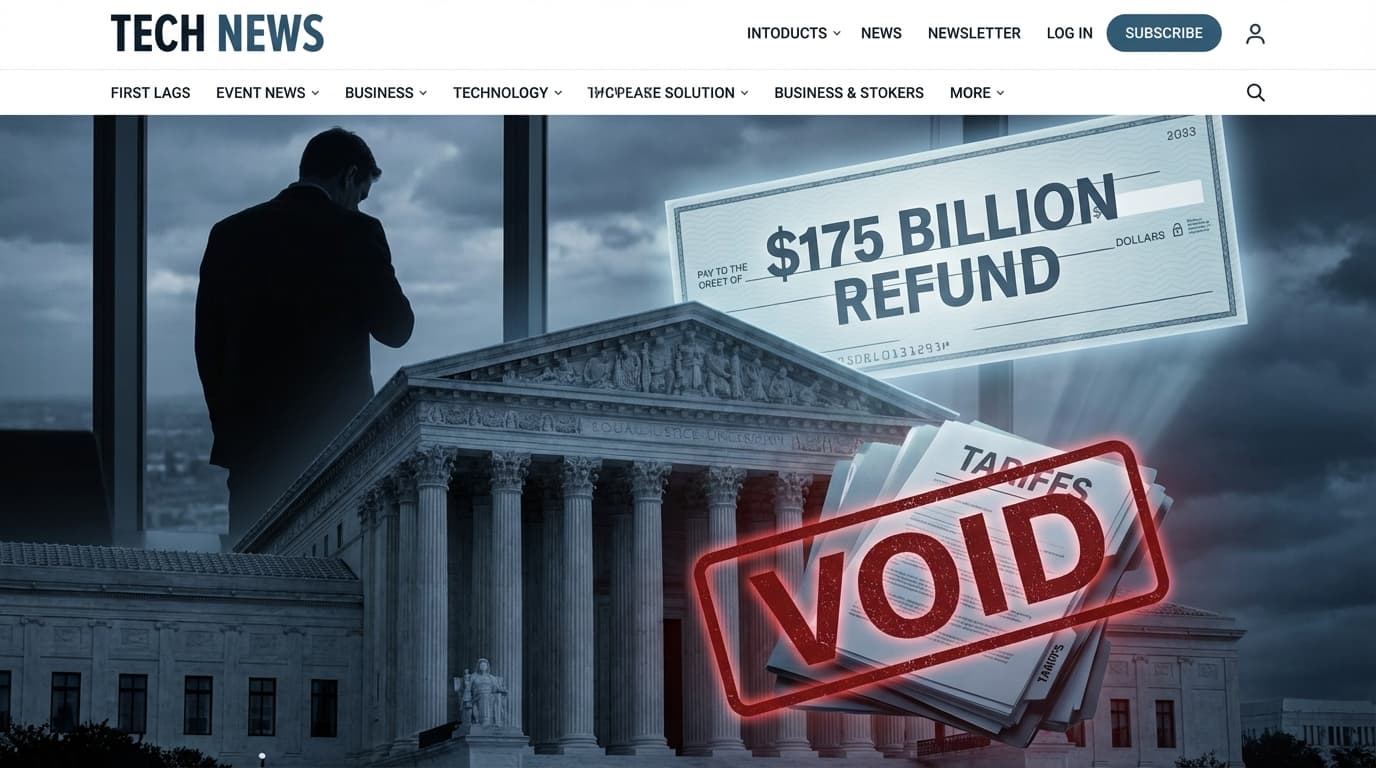
US Supreme Court Strikes Down Trump Tariffs, Government Faces $175 Billion Refund Bill
A Judicial Earthquake: 6-3 Ruling Challenges Presidential Trade Authority
In a landmark decision that could redefine the boundaries of executive power, the United States Supreme Court (SCOTUS) ruled 6-3 on February 20, 2026, that the administration’s use of the International Emergency Economic Powers Act (IEEPA) of 1977 to levy broad, global tariffs is unconstitutional. The ruling represents a devastating legal blow to the administration’s signature economic strategy and could force the U.S. government to refund an estimated $175 billion to impacted businesses.
Writing for the majority, the justices argued that while the president possesses broad authority during national emergencies, the IEEPA cannot be used as a "blank check" to bypass Congress’s constitutional role in regulating international commerce. As reported by Wired (2026), the court found that the administration failed to establish a specific national security link for the widespread duties applied to consumer goods.
The Legal Crux: Misuse of the 1977 IEEPA Law
The IEEPA was originally designed to allow the U.S. president to freeze assets and restrict trade with specific foreign adversaries in response to "unusual and extraordinary threats." However, the current administration expanded this to declare a generic national emergency regarding global trade imbalances, using it to impose tariffs on everything from steel to consumer electronics without Congressional approval.
According to a legal analysis by The Verge (2026), the court’s decision asserts that "national security" cannot be used as a convenient label to implement protectionist economic policies. The 6-3 conservative-leaning court emphasized that the power to "lay and collect taxes, duties, imposts and excises" is explicitly granted to Congress under Article I of the Constitution.
Financial Fallout: A $175 Billion Liability
The economic implications are staggering. Economists estimate that the U.S. government may now be liable for at least $175 billion in tariff refunds to importers and corporations that have paid these duties over the past several years. This potential payout comes at a time of high federal deficits, creating a significant fiscal crisis for the Treasury.
As noted by Ars Technica (2026), retail associations and manufacturing groups are already preparing class-action lawsuits to expedite the refund process. In response, President Trump signed a defiant executive order attempting to circumvent the ruling through alternative legal mechanisms, calling the justices a "disgrace" to the country Wired (2026).
Market Reactions and Global Trade Outlook
The news sent ripples through global markets. Google Trends data indicated that search interest for "SCOTUS Tariff Ruling" reached a maximum score of 100 in California and New York. Internationally, the ruling has been met with cautious optimism by trade partners, who view it as a return to a more predictable, rules-based trading system.
However, consumers shouldn't expect an immediate drop in prices. Wired (2026) warns that other inflationary factors, such as high interest rates and logistics costs, remain in play. Furthermore, the ruling specifically targets IEEPA-based tariffs; duties imposed under other statutes, such as Section 301 (focused on China), may remain unaffected by this specific judicial decision.
The Future of Checks and Balances
This case marks a turning point in the relationship between the Executive Branch and the Judiciary. For decades, the courts have generally deferred to the president on matters of national security and foreign policy. This ruling signals that the "national security" defense has limits, especially when it encroaches on the legislative branch’s financial and trade authorities.