

A Milestone in Human History: Moving a World
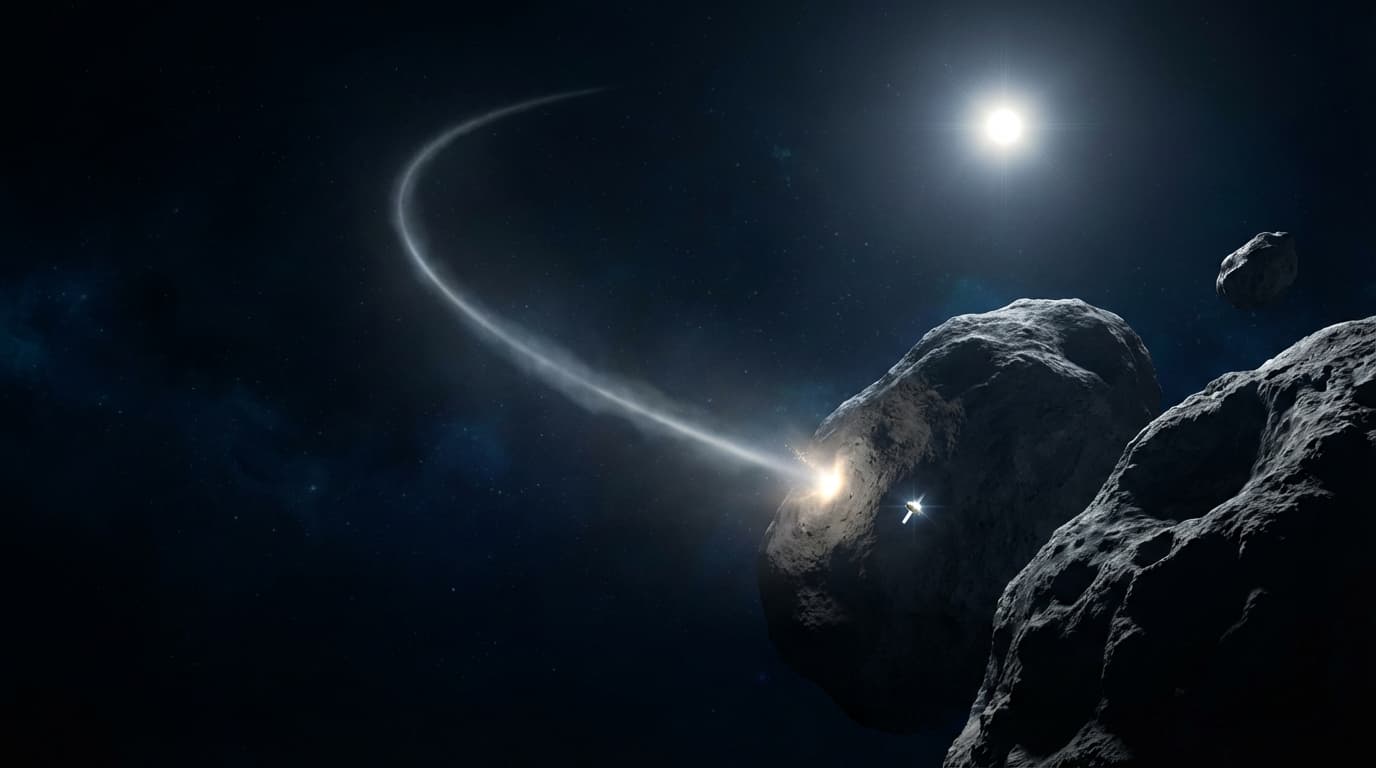
On March 6, 2026, a groundbreaking study published in Science Advances confirmed a feat once thought to be the realm of science fiction: humanity has successfully altered the heliocentric orbit of a celestial body. This conclusion is the culmination of years of data analysis following NASA's Double Asteroid Redirection Test (DART) mission, which saw a spacecraft intentionally crash into the asteroid moon Dimorphos in late 2022. While initial reports focused on the change in Dimorphos’s rotation around its primary companion, Didymos, the latest findings reveal that the impact was powerful enough to shift the barycenter of the entire binary system, altering its 2.1-year journey around the Sun.
As reported by Science News, this represents the first-ever human-caused change to the orbital mechanics of the solar system. It transitions humanity from being passive observers of celestial motion to active participants capable of sculpting planetary paths. This verification provides a definitive baseline for planetary defense strategies, proving that kinetic impactors can indeed protect Earth from potential asteroid threats.
The Physics of Deflection: The Ejecta Boost
The research utilized high-precision stellar occultation and radar measurements to quantify the deflection. One of the key findings was the role of "ejecta"—the massive cloud of debris blasted away from the asteroid upon impact. This debris acted as a propellant, providing a recoil force that amplified the spacecraft's initial kinetic energy. Scientists estimate that this "beta factor" (the ratio of momentum transferred to the momentum of the spacecraft) was significantly higher than predicted, thanks to Dimorphos’s "rubble pile" composition.
Ars Technica noted that these results have major implications for future mission designs. Because rubble pile asteroids are common, a relatively small kinetic impactor can have a disproportionately large effect on their trajectory. This is critical information for mission planners who may only have a short lead time to intercept a newly discovered threatening asteroid.
Institutional Shifts: The Death of the EUS
While the DART mission is celebrated as a high-water mark for NASA’s innovation, it comes amidst a brutal prioritization of the agency's budget. The "Exploration Upper Stage" (EUS), designed for the heavy-lift Space Launch System (SLS), has been officially discontinued. The decision signals a strategic pivot by NASA to move away from expensive, legacy hardware toward more agile and cost-effective technologies that directly support planetary defense and lunar exploration via commercial partners.
International discussions are already shifting toward the legal and geopolitical ramifications of orbital deflection. If a rogue asteroid's path is altered, who decides its new trajectory? If a deflection intended to save one continent inadvertently places another at risk, where does the liability lie? These questions are no longer theoretical; they are now the subject of urgent debate at the UN Committee on the Peaceful Uses of Outer Space.
Future Horizons: The Hera Mission and Beyond
The next phase of planetary defense is already in motion. The European Space Agency’s (ESA) Hera mission is scheduled to arrive at the Didymos system in late 2026 to conduct a post-impact "crime scene investigation." Hera will deploy cubesats to measure the mass of Dimorphos with extreme precision and map the crater left by DART.
Looking ahead, the scientific community is advocating for a global "Planetary Shield" framework—a collaborative effort to maintain kinetic impactors in high-earth orbit or on the lunar surface, ready for rapid deployment. As we decode the full lessons of DART, humanity is finally building the tools to ensure that, unlike the dinosaurs, we have a say in our planet’s destiny.