
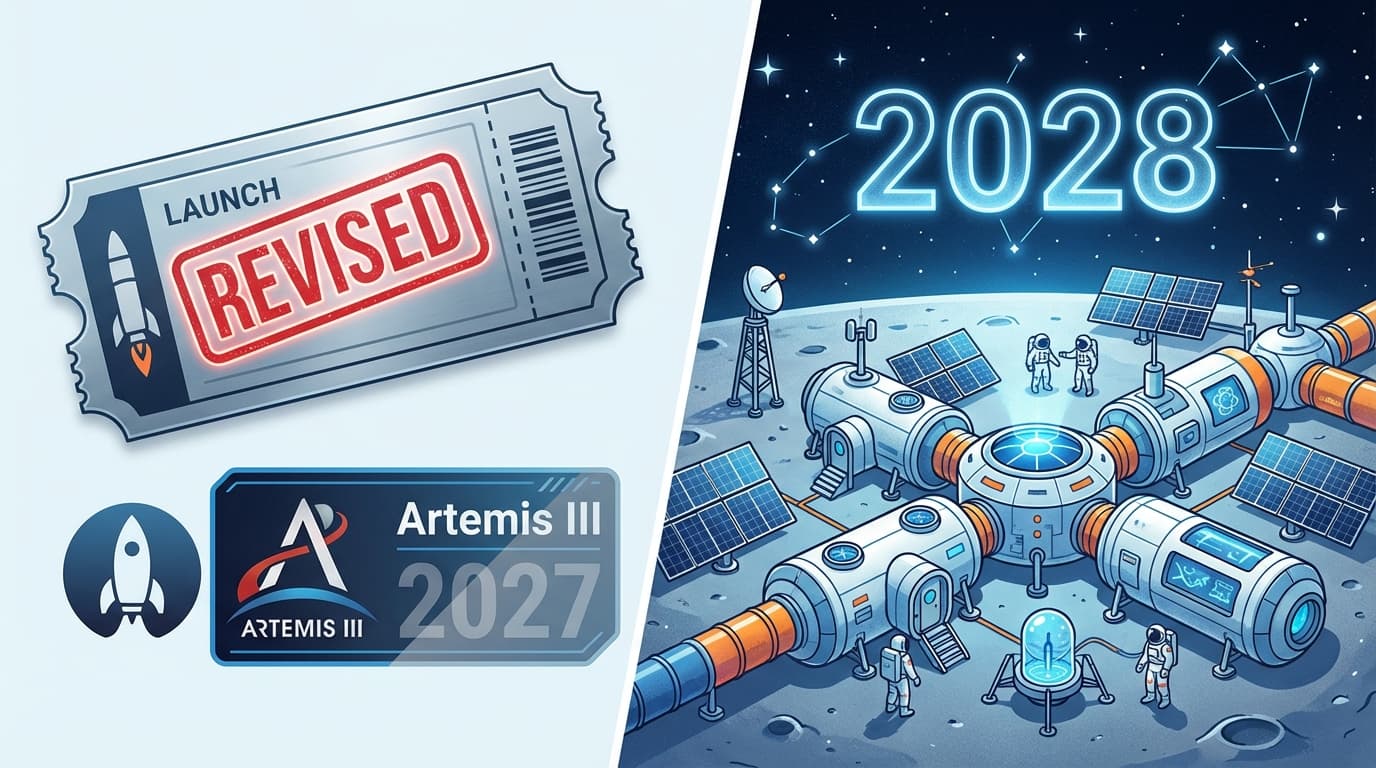
Realignment: The Artemis Reality Check
NASA has officially announced a strategic overhaul of its flagship Artemis program, confirming that the high-stakes 2027 lunar landing (Artemis III) has been cancelled in its current form. As reported by Science News (2026), the mission has been repurposed to focus on docking procedures and advanced spacesuit testing in Low Earth Orbit (LEO) rather than attempting a human landing on the lunar surface.
New Leadership: Jared Isaacman’s Agile Approach
This strategic pivot comes under the guidance of NASA’s new Administrator, Jared Isaacman. Known for his leadership of the Polaris Dawn private space missions, Isaacman is injecting a corporate 'move fast' mentality into the agency’s long-term planning. Wired (2026) reports that Isaacman’s priority is to trade a hasty 2027 landing for a dual-mission surge in 2028, which aims to establish a more sustainable operational cadence for lunar exploration.
Technical Bottlenecks: Spacesuits and Starship Integration
The delay is rooted in critical hardware hurdles. Development of the next-generation lunar EVA suits has faced consistent setbacks, and complex docking maneuvers between the Orion capsule and SpaceX’s Starship HLS (Human Landing System) require additional validation. By shifting the 2027 focus to LEO testing, NASA hopes to de-risk the 2028 missions, which are now planned to include the deployment of initial scientific infrastructure on the Moon rather than a simple 'flags and footprints' visit.
The Commercial Conflict: Public-Private Realities
Analysts suggest that the Artemis reshuffle highlights the inherent friction in public-private space partnerships. While contractors like SpaceX and Axiom Space operate on aggressive timelines, NASA’s stringent safety requirements for human-rated flight often necessitate schedule adjustments. Academic discussions on long-term lunar habitation (e.g., ArXiv:2602.23364v1) emphasize the need for robust life-support validation before committing to deep-space missions, a standard Isaacman appears keen to uphold despite the optics of a delay.
Looking Ahead: Is 2028 the New Year of the Moon?
With 2027 now serving as a year of foundational testing, the pressure on the 2028 launch window is immense. The success of Isaacman’s strategy depends on the upcoming 12 months of orbital trials. For the United States, this pivot isn't just about delay; it's a recalibration intended to ensure that when humans do return to the Moon, they are there to stay.