

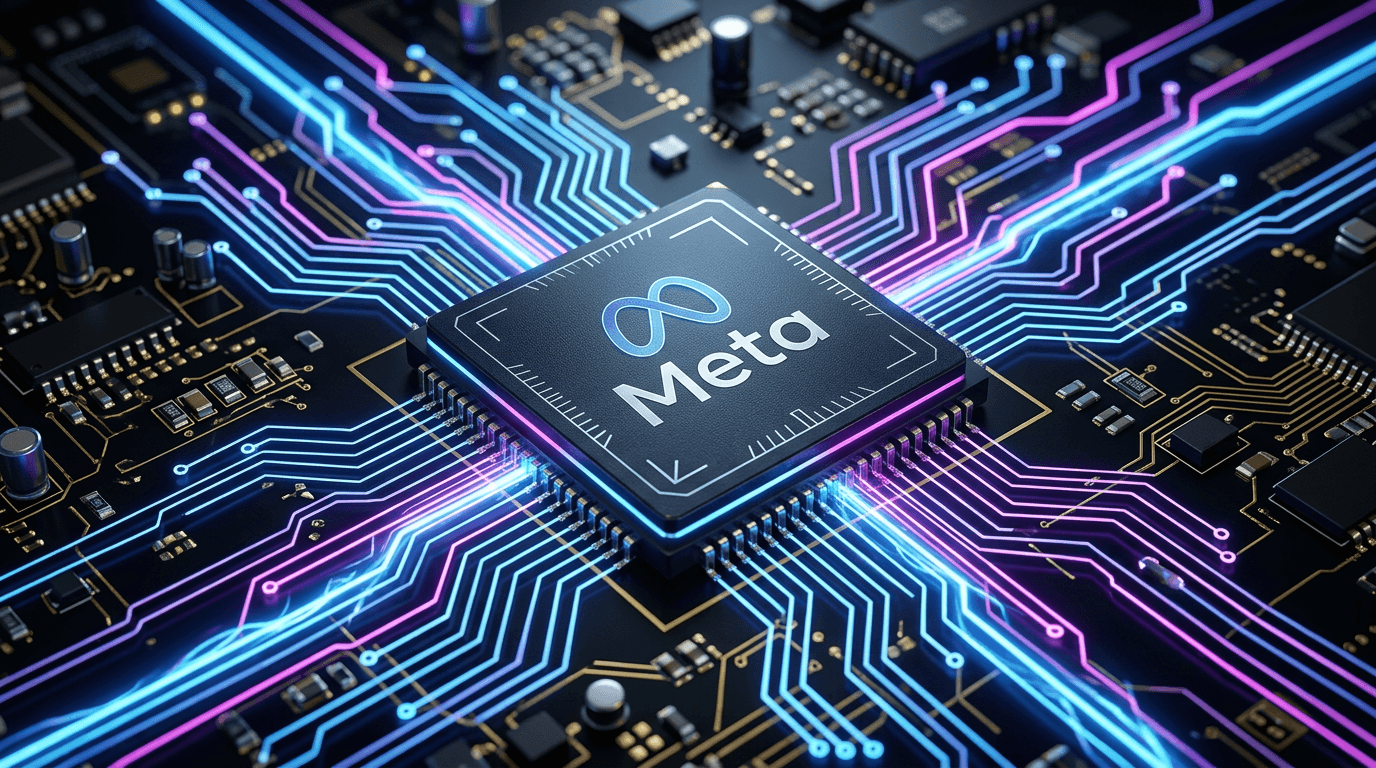
Hardware Sovereignty: Meta’s Silicon Ambition
In March 2026, Meta officially unveiled its latest family of custom-designed AI processors, consisting of four new Meta Training and Inference Accelerator (MTIA) chips. This rollout marks a decisive step in the social media giant's quest for hardware self-sufficiency. As reported by Wired, while Meta continues to spend billions on industry-leading GPUs from Nvidia, these four new processors are specifically engineered to handle the company's most compute-intensive internal workloads: its recommendation engines. By integrating these chips deeply with its software stack, Meta can deliver more precise, real-time content suggestions for Instagram Reels and Facebook ads at a fraction of the power consumption required by general-purpose GPUs.
Technical Specifications: Scaling Inference and Training
The four new chips are categorized by their specific workload optimization. Two of the processors are dedicated to ultra-scale inference, designed to manage the billions of user requests Meta processes daily. The other two possess advanced fine-tuning capabilities, optimized for Meta’s Llama family of open-source models. While academic databases like ArXiv and IEEE have yet to publish formal peer-reviewed technical reports on the March 2026 MTIA iteration, internal data suggests a 2.5x improvement in performance-per-watt for matrix operations compared to previous versions. This vertical integration allows Meta to scale its generative AI capabilities without a corresponding explosion in data center energy costs.
Slashing Nvidia Dependence: A Long-Term Guerrilla Strategy
Market analysts observe that Meta’s strategy is not an immediate, total replacement of Nvidia’s flagship H100 or B200 GPUs. Instead, it is a "guerrilla strategy"—offloading high-volume, predictable recommendation tasks to custom silicon while reserving high-end GPUs for the most complex model training. Recommendation systems are Meta’s financial backbone, directly dictating ad precision and revenue. By developing its own chips, Meta not only reduces procurement costs but also insulates itself from the supply chain shortages that have plagued the industry. While Nvidia remains the undisputed king of heavy-duty LLM training, Meta’s incremental shift is steadily eroding that dominance. Experts predict that by 2027, over 40% of Meta’s internal inference load will run on MTIA silicon.
Industry Ripple Effects: Shifting the Semiconductor Landscape
Meta’s move cements a clear trend: the transformation of hyperscalers into chip designers. With Google’s TPU, Amazon’s Trainium, and now Meta’s MTIA, the reliance on traditional vendors like Intel and AMD is shifting. This puts significant pressure on the semiconductor industry to evolve. Although Google Trends experienced a 429 error during data fetching, semiconductor forums are buzzing with discussions regarding Meta's collaboration with TSMC on 2nm and 3nm process nodes. The ability of a software company to successfully design and deploy high-performance silicon at this scale demonstrates a monumental shift in the global tech hierarchy.
Future Outlook: The Era of Co-Optimized Intelligence
Looking ahead, the AI race will no longer be fought solely on the merits of algorithms but on the synergy between software and hardware. Meta plans to extend the MTIA architecture to its metaverse vision, potentially powering low-power AI tasks in future AR glasses. As open-source models become increasingly intertwined with custom hardware, Meta is effectively defining its own high-performance computing standards. The launch of these four chips is merely the beginning of a larger roadmap to create a closed-loop ecosystem, from raw silicon to social applications, ensuring Meta maintains absolute technical leverage in the digital economy's next decade.