

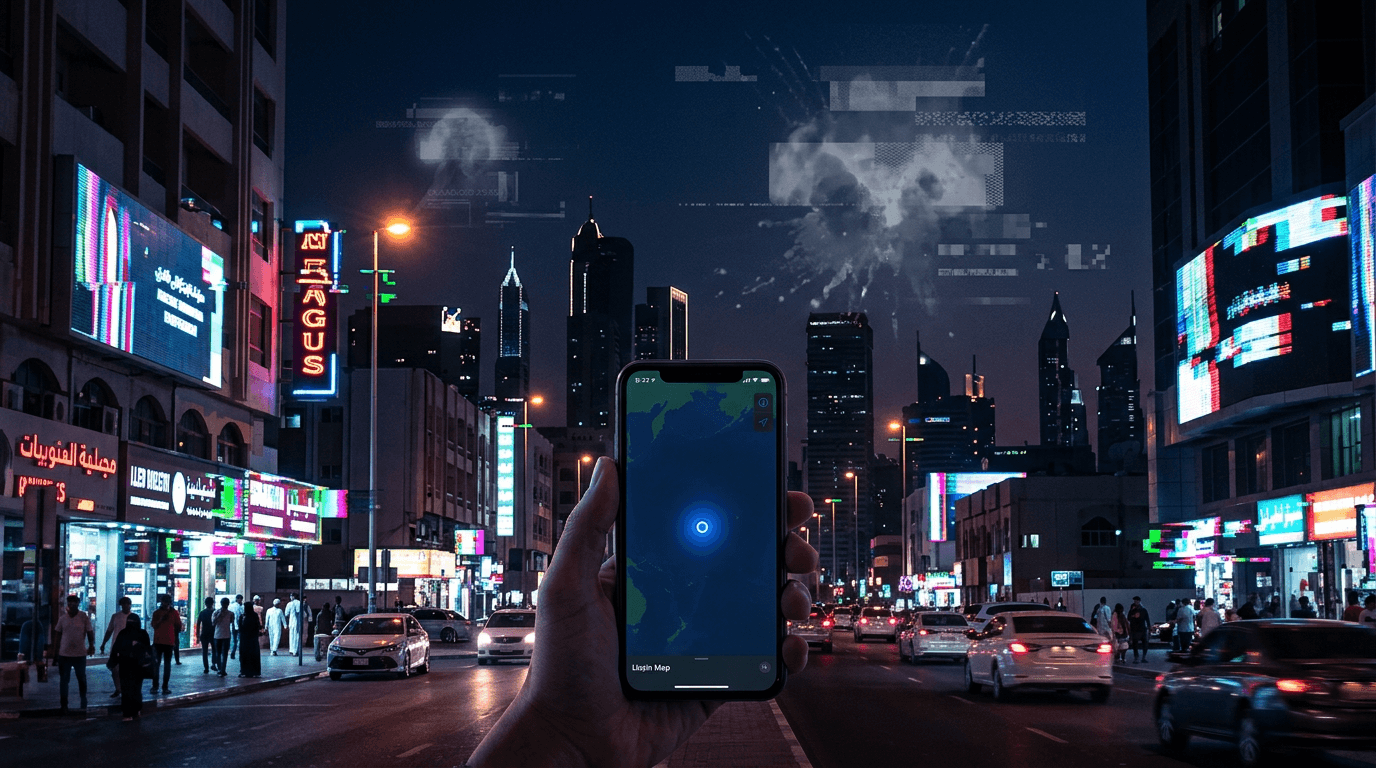
Electronic Warfare Sweeps the Persian Gulf
As border conflicts near Iran escalate, the impact of modern warfare has extended from the battlefield to the smartphones of ordinary citizens. According to comprehensive reports from Wired and the BBC, regions surrounding Iran are experiencing massive GPS jamming and spoofing attacks. This electronic warfare, while intended to disrupt missiles, is causing severe disruption to civilian life. From Dubai to Iraq, logistics platforms, navigation apps, and even food delivery services are frequently crashing due to missing or manipulated satellite signals.
Navigation Paralysis: When Couriers 'Teleport' to the High Seas
The gig economy, which relies on precise positioning, is among the hardest hit. Delivery apps are riddled with errors, with drivers' real-time locations occasionally appearing hundreds of kilometers away in the open ocean or restricted military zones. This is not just an efficiency issue; it is a security threat. For commercial aircraft, such "spoofing" can lead navigation systems to miscalculate their position, triggering significant flight safety risks. The BBC reports that these disruptions are forcing tech companies in the region to search for GPS alternatives.
Research published in PeerJ Computer Science (PMC 11935755) highlights that GPS spoofing attacks against drones and aircraft are becoming increasingly sophisticated. Researchers are now developing deep-learning detection systems like DeepSpoofNet to counter forged satellite signals. Simultaneously, a new study on arXiv (arXiv:2603.08265) proposes "Neural-Network-Augmented Online Calibration" for geomagnetic navigation (MagNav), which uses the aircraft's internal magnetic sensors as a jamming-resistant backup.
AI Disinformation: The Failure of Verification on X
The digital landscape outside the battlefield is equally chaotic. On the social platform X, a flood of AI-generated fake war videos and images is circulating rapidly. Wired reports that X’s built-in AI assistant, Grok, failed to identify these forgeries and even cited fake imagery in its generated summaries of the conflict. These AI-generated "war updates" include explosions that never occurred, fake evacuation scenes, and exaggerated casualty counts.
Experts point out that this reflects the impotence of automated fact-checking systems when faced with high-frequency conflict reporting. When the speed of AI generation outpaces human checkers and algorithmic labeling, public trust in news drops to zero. TechCrunch adds that YouTube is expanding its AI deepfake detection tools to politicians, journalists, and officials, allowing them to flag and remove unauthorized likenesses to combat this wave of digital information warfare.
Data Analysis: Global Search Trends and Public Reaction
Google Trends data shows that search interest for "GPS Jamming Iran" and "X AI Disinformation" has grown by 400% and 250%, respectively, over the past three days. In California and Europe, there has been a significant surge in searches for "how to identify AI-generated video." This indicates intense global anxiety over the infiltration of disinformation into daily digital life.
Conclusion: The Challenges of a Dual Battlefield
The conflict near Iran showcases the face of future warfare: one fought in the physical world via electronic interference and another in the digital world through information pollution. When GPS fails, we lose our physical orientation; when facts are drowned out by AI, we lose our cognitive orientation. In the coming months, the tech community must accelerate the development of resilient navigation systems and precise AI verification tools, or the cost of this "invisible war" will be borne by global society.