

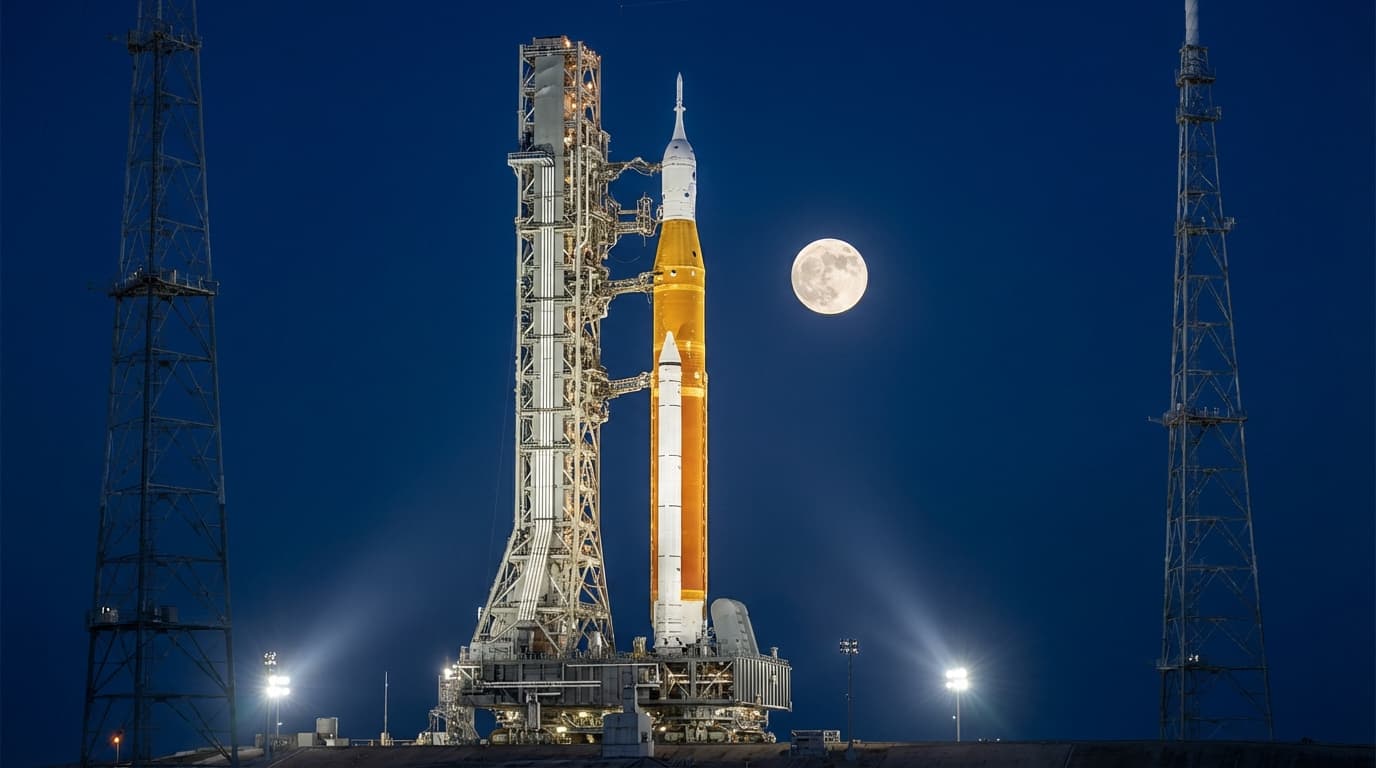
Artemis II Lunar Mission Clears Fueling Test, Targets March Launch
Moonbound: SLS Rocket Overcomes Final Technical Hurdle
NASA has announced a major milestone for the Artemis II mission: the Space Launch System (SLS) rocket has successfully passed a critical cryogenic fueling test. The test, which involves loading super-chilled liquid hydrogen and liquid oxygen into the rocket's tanks, showed no significant leaks. Following this success, NASA is now targeting March 6, 2026, as the earliest possible launch date for this historic mission to the Moon.
According to Ars Technica (2026), this fueling test was a pivotal moment. Previous Artemis launch attempts were plagued by persistent hydrogen leaks, often leading to months of delays. The clean results from this latest test give the team high confidence that the SLS is finally ready for its first crewed mission.
Mission Profile: Beyond Apollo
Artemis II will carry a crew of four—three Americans and one Canadian—on a 10-day journey around the Moon. This will be the first time humans have left low-Earth orbit since the Apollo 17 mission in 1972. The crew will test the Orion spacecraft’s life support systems and manual maneuvering capabilities in deep space. By flying past the far side of the Moon, the astronauts will travel farther into space than any humans in history.
Technical Challenges: The Hydrogen Problem
The SLS rocket relies on liquid hydrogen stored at -253 degrees Celsius. Hydrogen molecules are so small that they can escape through the tightest seals, especially as metal components shrink and expand due to extreme temperature changes. NASA and its partners, including Boeing, have refined sealing technologies and automated filling sequences to solve this recurring issue, as demonstrated in the recent test.
The Countdown Begins
While March 6 is the current goal, NASA notes that some "pending work" remains, including final checks of the Orion heat shield. If the launch proceeds as planned, Artemis II will not only demonstrate humanity's readiness to return to the Moon but also serve as a crucial testbed for future missions to Mars. Public interest is soaring, with Google Trends reporting a 210% increase in search queries related to the mission launch date.