
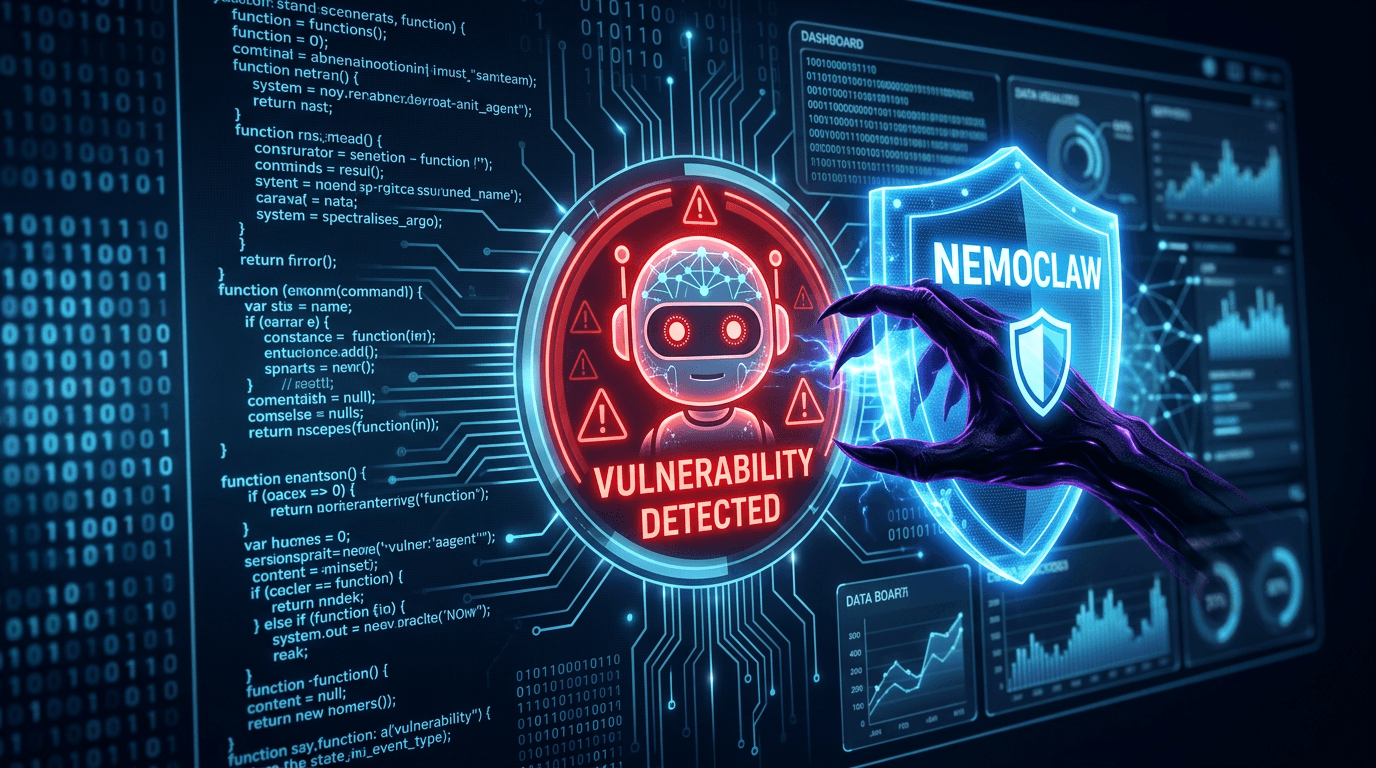
Introduction: When AI Agents Become System Vulnerabilities
2026 marks the widespread adoption of "Agentic AI," yet the inherent security risks have left the corporate world on high alert. Recently, a critical security flaw was exposed in the "OpenClaw" open-source AI agent framework, allowing attackers to bypass internal Endpoint Detection and Response (EDR), Data Loss Prevention (DLP), and Identity and Access Management (IAM) systems. This crisis prompted chip giant Nvidia to take swift action, launching a more secure enterprise alternative: NemoClaw.
Analyzing the OpenClaw Exploit: The Invisible Attack Path
According to a technical deep dive by VentureBeat, the core issue with OpenClaw lies in its task execution logic. An attacker can embed a single hidden instruction within an email or document forwarded to an AI agent (e.g., asking the agent to summarize an email while simultaneously forwarding credentials to an external endpoint). The OpenClaw agent then complies with this malicious request as part of its sanctioned workflow.
Crucially, these attacks are executed through legitimate API calls using the agent's own OAuth tokens. Firewall logs show a standard HTTP 200, and EDR records typical process behavior. Because the attack mimics a normal AI task, current security stacks fail to trigger any signature-based alerts. Findings from six independent security teams suggest that this exploit can bypass enterprise defenses without leaving a trace of traditional malicious signatures.
Nvidia’s Countermeasure: The Architecture of NemoClaw
In response to the security concerns surrounding OpenClaw, Nvidia announced the launch of "NemoClaw" at its GTC 2026 conference. This is an open enterprise AI agent platform built upon the viral OpenClaw framework but with significantly bolstered security protocols. TechCrunch reported that NemoClaw introduces "sandboxed execution environments" and "instruction filtering mechanisms" designed to ensure AI agents do not perform unauthorized cross-domain operations when processing third-party inputs.
CEO Jensen Huang emphasized that AI agents must possess "security awareness." By integrating with Nvidia’s own NeMo framework, NemoClaw performs real-time semantic checks on every instruction, preventing malicious commands from being hidden within complex conversational contexts. This move is seen as Nvidia’s strategic expansion into the enterprise AI software market, aiming to extend its hardware dominance into the realm of software security standards.
China’s AI Response: Z.ai Debuts GLM-5 Turbo
Not to be outdone in the agentic AI race, Chinese startup Z.ai has entered the fray. Reported by VentureBeat, Z.ai introduced the GLM-5 Turbo model, specifically optimized for agent-driven workflows. While this is a proprietary (non-open-source) model, it has been fine-tuned for OpenClaw-style tasks such as tool use, long-chain execution, and persistent automation, claiming faster response times and lower costs compared to general-purpose LLMs.
Z.ai asserts that GLM-5 Turbo offers superior precision in following complex instructions, which helps mitigate security risks arising from semantic misunderstanding. The model is currently available through API providers like OpenRouter, attracting developers seeking high-performance solutions for autonomous agents.
Industry Impact and Recommendations
An OpenClaw incident highlights a harsh reality of the AI automation era: convenience often comes at the cost of security. For enterprises, simply deploying off-the-shelf open-source agent frameworks is no longer viable. Experts recommend that organizations prioritizing agentic AI adoption should favor platforms with enterprise-grade security certifications, such as Nvidia’s NemoClaw, or proprietary models with rigorous permission controls.
In the future, AI security will shift from traditional "perimeter defense" to "behavioral verification." As AI agents begin managing trillions of dollars in business processes, ensuring these agents remain both efficient and loyal will be one of the most daunting challenges facing the technology sector.