
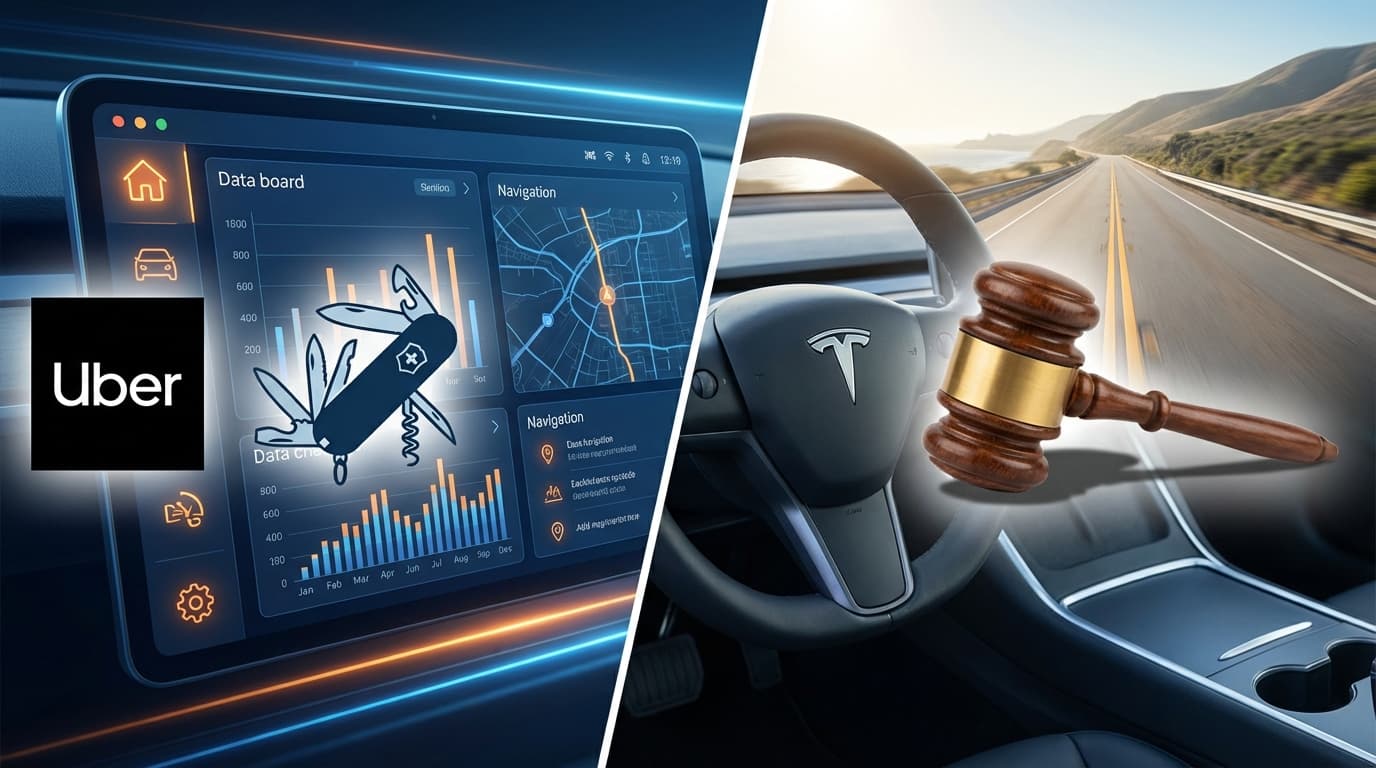
Uber Shifts to Robotaxi Support as Tesla Pursues Autopilot Legal Battle
Introduction: The Dual Tracks of Autonomous Evolution
As 2026 unfolds, the autonomous vehicle (AV) industry finds itself at a defining crossroad. On one side, Uber, which once harbored ambitions of developing its own self-driving cars, has fully pivoted into a "Swiss Army Knife" for the robotaxi ecosystem. On the other, industry pioneer Tesla remains entrenched in a protracted legal struggle with the California Department of Motor Vehicles (DMV) over the marketing of its "Full Self-Driving" (FSD) system. These diverging paths highlight the profound shifts in business models and regulatory pressures currently reshaping the AV landscape.
Uber’s Strategic Pivot: From Developer to Infrastructure Provider
Uber recently unveiled its Uber Autonomous Solutions division, marking the final stage of its transformation into a service-first company. As reported by TechCrunch (2026), the company is no longer interested in building the "brain" or the "body" of the vehicle. Instead, it aims to provide the essential life-support systems for everyone else's autonomous fleets.
This new suite of software and physical services addresses the operational friction points of the robotaxi industry. Services include professional fleet maintenance, cleaning, specialized charging infrastructure, and advanced dispatching algorithms. Uber’s goal is to become the indispensable platform for all AV partners—ranging from robotaxis and self-driving trucks to sidewalk delivery robots—leveraging its massive user base without the high-risk costs of hardware R&D.
Tesla’s Legal Quagmire: Autopilot vs. the DMV
While Uber builds bridges with partners, Tesla is building legal fortifications. On February 23, 2026, Tesla filed a fresh lawsuit against the California DMV, attempting to block the agency’s efforts to regulate how the company markets its Autopilot and FSD features.
The core of the dispute, according to TechCrunch (2026), is whether Tesla’s branding constitutes deceptive marketing. The DMV alleges that the name "Autopilot" misled consumers into believing the vehicles were fully autonomous, violating California Consumer Protection laws (Bus. & Prof. Code § 17200). Tesla argues that the DMV is overstepping its regulatory bounds and that safety standards for vehicle automation should be governed by federal authorities like the NHTSA.
Expert Analysis: Redefining Liability and Authority
Legal analysts suggest that the diverging paths of Uber and Tesla reflect a broader attempt to redefine liability in the AI era. By positioning itself as a "software-as-a-service" provider, Uber may successfully insulate itself from direct operational liability, shifting the burden to vehicle owners or hardware manufacturers.
Tesla’s vertical integration, by contrast, puts it on the front lines of every legal challenge following an Autopilot-involved accident. While this strategy captures more of the profit margin, it also creates significant regulatory volatility. In California, which serves as a bellwether for AV policy, the outcome of this case will set a precedent for how AI-driven products are marketed nationwide.
Market Impact: The ROI Challenge in AV Operations
Despite the legal headwinds, the economic promise of autonomous systems is becoming tangible. A survey of 1,100 developers and CTOs by VentureBeat (2026) revealed that 67% of organizations using autonomous systems are reporting productivity gains, even as they struggle with governance.
Uber’s new unit targets these organizations looking to improve their Return on Investment (ROI). As companies like Waymo expand operations in cities like Phoenix and San Francisco, the demand for services that lower operational expenses (OpEx) is surging. This explains why Uber is accelerating its platform launch even as Tesla remains distracted by courtroom battles.
Future Outlook: Transparency and Standardization
In the coming year, the AV industry will likely focus on two major themes: transparency and standardization. The release of interpretable AI models like Steerling-8B by Guide Labs TechCrunch (2026) points to a future where autonomous decision-making processes are open to regulatory audit.
For Tesla, the challenge is to prove its systems are safe and accurately represented without compromising its market edge. For Uber, the goal is to demonstrate that it can create a unified service standard across competing autonomous technologies. 2026 will be the year we decide if autonomous driving is a standalone product or a universal utility.
FAQ Section
Q1: Why did Uber stop developing its own self-driving cars? A: The R&D costs and safety liabilities were too high. Uber realized its core strength lies in its network and marketplace, making it a better fit as a service platform for other AV companies.
Q2: Could the Tesla vs. DMV lawsuit lead to a ban on FSD in California? A: A total ban is unlikely, but Tesla may be forced to change the feature’s name or implement much stricter warnings and driver-monitoring requirements within the state.
Q3: What exactly does Uber Autonomous Solutions offer to partners? A: It provides a "Swiss Army Knife" of services, including physical car cleaning/maintenance, energy management (charging), and AI-driven dispatching software to optimize fleet usage.
Q4: Why is "interpretable AI" important for self-driving cars? A: It allows regulators and engineers to understand why an AI made a specific choice in a critical moment. This is essential for safety audits and determining insurance liability after accidents.
References:
- [src-1] TechCrunch. Uber wants to be a Swiss Army Knife for robotaxis. (2026).
- [src-2] TechCrunch. Tesla’s battle with the California Department of Motor Vehicles isn’t over after all. (2026).
- [src-3] VentureBeat. AI Agents are delivering real ROI — Here's what 1,100 developers reveal. (2026).