

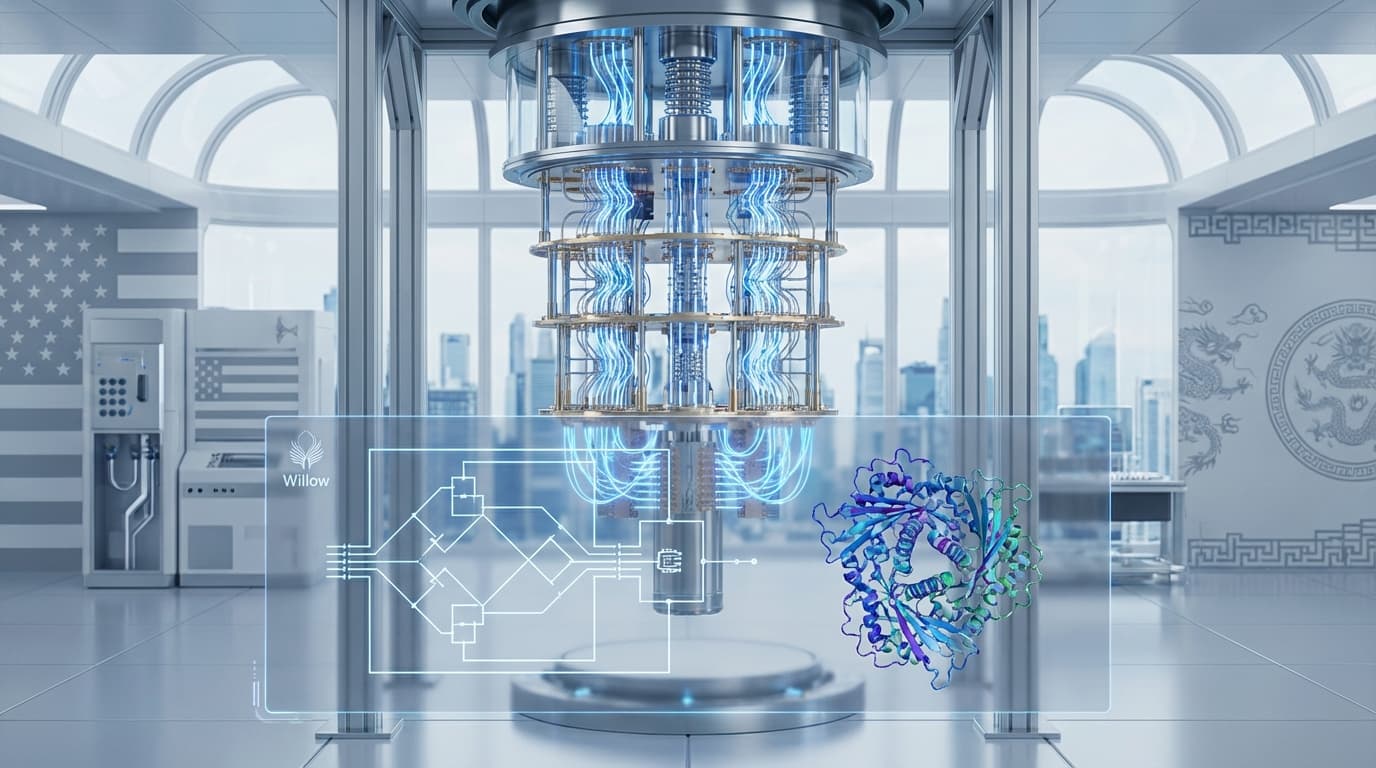
Quantum Computing 2024-2025: From Lab to Industry as US-China Rivalry Enters the Logical Qubit Era
The period of 2024-2025 marks a definitive paradigm shift in the quantum computing landscape. The global tech community has moved beyond the race for raw "physical qubit" counts, pivoting instead toward the realization of Logical Qubits and robust Quantum Error Correction (QEC). This transition signals the end of the early NISQ (Noisy Intermediate-Scale Quantum) era and the beginning of an industrial validation phase.
Hardware Milestones: The Race for Fault Tolerance
Google and IBM: Superconducting Supremacy
In late 2024, Google unveiled its "Willow" chip, a 105-qubit processor protected by patent US12165008B2. The breakthrough lies in its "tiling" architecture, which allows error rates to decrease as more qubits are added—a fundamental requirement for scalable quantum computing. IBM, meanwhile, has doubled down on its qLDPC (Quantum Low-Density Parity-Check) codes. By utilizing "Bivariate Bicycle Codes," IBM demonstrated that it could achieve 12 logical qubits using only 288 physical qubits, a massive leap in efficiency over traditional surface codes.
Microsoft: The Topological Breakthrough
Microsoft’s long-term bet on topological qubits paid off in early 2025 with the Majorana 1 chip. Leveraging Majorana zero modes (MZMs), this architecture offers inherent protection against environmental noise. The patent (US20250272587A1) detailing its "Tetron" structure positions Microsoft as a formidable challenger to the superconducting status quo.
China’s Strategic Consolidation
China now accounts for approximately 60% of global quantum patent applications. A significant trend in 2024 was the consolidation of research under the "National Team." Tech giants like Alibaba and Baidu donated their quantum facilities to state institutes, streamlining resources for national strategic goals. Origin Quantum emerged as a key player, launching the "Wukong" 72-qubit system with 80% localized components, effectively bypassing Western export controls on dilution refrigerators and microwave modules.
Commercial Verticals: Pharma and Materials
The industrial application of quantum computing has accelerated in two primary sectors:
- Pharmaceuticals: Companies like Tencent Quantum Lab are using hybrid quantum-classical algorithms to solve the "computational bottleneck" in molecular docking. These tools are now being used to predict how large, complex drug molecules interact with target proteins with unprecedented accuracy.
- Material Science: EV battery leaders like CATL have integrated quantum sensors into their manufacturing lines to detect microscopic flaws. Additionally, neutral-atom systems like the Hanyuan-1 (launched Oct 2025) are being used to optimize renewable energy grids and simulate new catalysts for green energy.
Legal and Regulatory Landscape
A landmark ruling by the USPTO’s PTAB in the Ex parte Yudong Cao case (2024) has provided a blueprint for protecting quantum software. By ruling that hybrid algorithms constitute a "technical improvement" rather than an abstract idea, the board has cleared the way for a surge in software patenting. However, national security remains a priority, with the USPTO increasing scrutiny on patent challenges to protect domestic intellectual property from foreign influence.
Future Outlook (2026-2030)
As we look toward 2026, the focus will shift to cross-licensing agreements as Google, IBM, and Microsoft cross the error-correction threshold. In China, the focus will be on the "industrialization" of patents, using IP as financial collateral to fund the next generation of quantum startups. The quantum decade is just beginning, and the stakes have never been higher.