

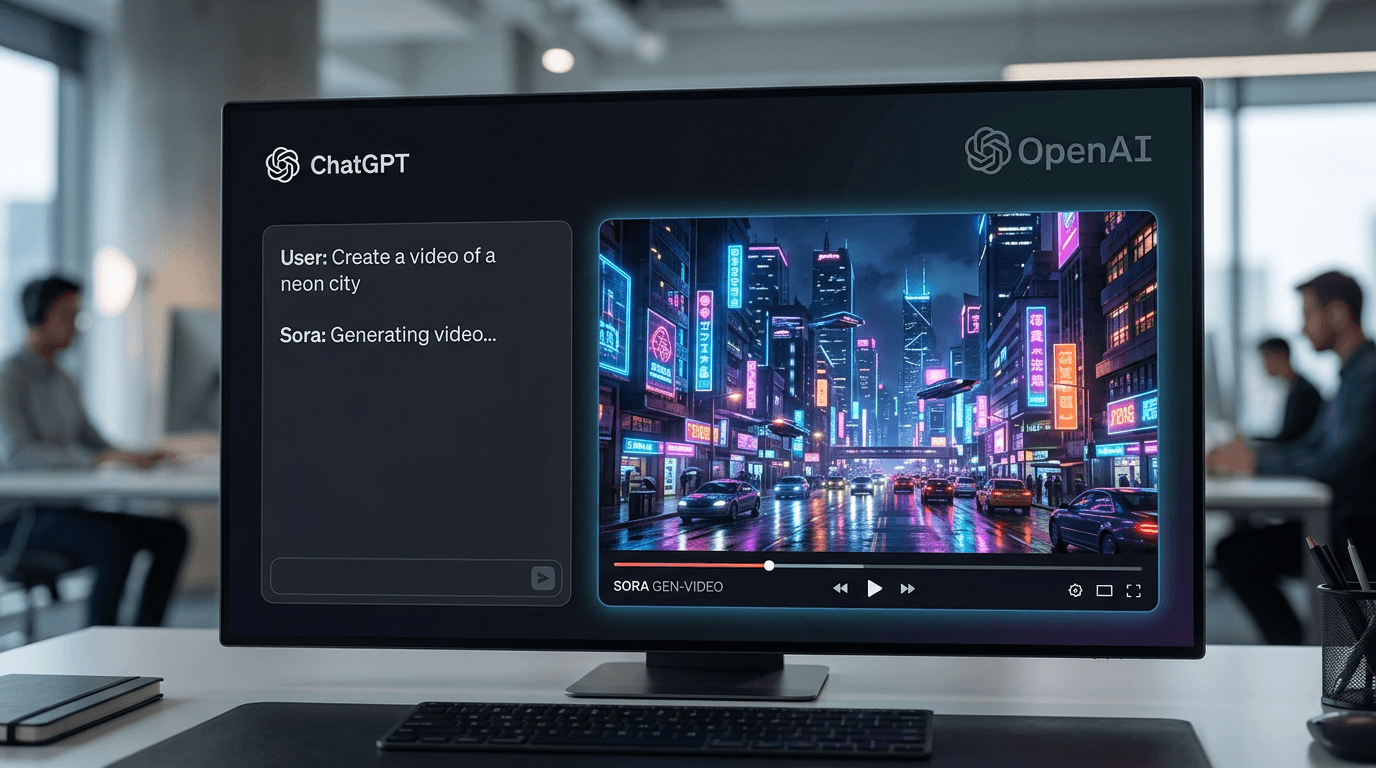
The Convergence of Power: Bringing Sora into the ChatGPT Orbit
Since its debut, Sora—OpenAI’s high-fidelity video generator—has been a technical spectacle, producing cinematic sequences that have stunned the world. However, despite its prowess, Sora’s path as a standalone product has been surprisingly complex. Recent internal metrics suggest that while interest is high, the engagement levels of a standalone Sora app have not kept pace with the viral momentum of ChatGPT. In a strategic maneuver to revitalize adoption, reports from The Information and The Verge indicate that OpenAI is preparing to integrate Sora directly into the ChatGPT interface, transforming the world's most popular chatbot into a comprehensive multimodal creation hub.
This integration mirrors OpenAI’s previous success with DALL-E 3. By embedding video generation within the familiar conversational flow of ChatGPT, the company aims to eliminate the friction inherent in switching between different creative tools. For users, this means that the act of brainstorming a script and generating a corresponding video can now happen in a single, continuous dialogue. This "one-stop-shop" strategy is designed to make advanced video synthesis accessible to the average user, rather than keeping it locked away in professional-grade standalone applications.
Solving the Engagement Gap: Why Standalone Apps Struggle
Industry analysts have noted a growing fatigue with fragmented AI tools. Users are increasingly resistant to managing multiple subscriptions and learning distinct interfaces for text, image, and video. Sora’s standalone app, while technically impressive, suffered from being outside the primary "workflow" of most users. ChatGPT is where the thinking happens; it is the starting point for creative ideation. By forcing users to export their ideas to a separate Sora platform, OpenAI inadvertently created a barrier to daily usage.
By folding Sora into ChatGPT, OpenAI can leverage its massive installed base to drive usage. The integration allows for a more cohesive monetization strategy, such as offering Sora "credits" or unlimited lower-resolution generation as part of a ChatGPT Plus or Team subscription. More importantly, it allows the LLM (Large Language Model) to act as a highly sophisticated "director." Instead of users struggling to write complex video prompts, they can simply tell ChatGPT, "Make a video of what we just discussed," and the LLM will translate the context into the precise technical instructions Sora requires.
Data Analysis: Global Anticipation and Search Trends
Google Trends data from March 11, 2026, reveals a significant spike in search queries for "Sora ChatGPT Integration" following the initial reports. This interest is particularly concentrated in tech-heavy regions such as California, London, and Tokyo. In Taiwan, interest in Sora has remained consistently high, but the potential for ChatGPT integration has triggered a 35% increase in related search volume over the last 48 hours. This data suggests that the market sees integration as the "missing link" that will make AI video generation practical for business and educational use.
Financial observers suggest that this move is also a defensive measure against competitors like Google Gemini, which has made significant strides in native multimodal capabilities. If OpenAI fails to provide a seamless video experience within its flagship product, it risks losing power users to ecosystems that offer better cross-modality integration. The data confirms that users are no longer looking for siloed AI capabilities; they are looking for a unified intelligence that can handle any media format interchangeably.
Regulatory Hurdles: The Stakes of Mass-Market AI Video
The mass integration of Sora into ChatGPT brings significant ethical and regulatory challenges. When a technology as powerful as Sora becomes available to hundreds of millions of people at the click of a button, the risks of misinformation, deepfakes, and copyright infringement grow exponentially. Wired has previously reported on the ongoing controversy surrounding Sora’s training data, and mass availability will only intensify these legal debates. OpenAI will need to implement robust guardrails and invisible watermarking to ensure the technology is used responsibly.
Furthermore, the computational cost of generating video for millions of concurrent users is astronomical. This "compute bottleneck" may mean that Sora within ChatGPT is initially launched with significant limitations on video length or resolution, or restricted to higher-tier paying customers. Balancing the technical demands of video rendering with the user experience of a real-time chatbot will be one of the greatest engineering feats in OpenAI's history. Legal experts also warn that as the EU AI Act enters its full enforcement phase, OpenAI's safety protocols will be under intense scrutiny from global regulators.
Outlook: A New Standard for Multimodal AI
As we look toward the end of 2026, the integration of Sora into ChatGPT could set a new industry standard for what an "AI Assistant" truly is. We are moving toward a future where the distinction between writing, drawing, and filming is blurred by a single, intelligent interface. For marketers, educators, and social media creators, this integration represents a massive leap in efficiency, allowing for the rapid prototyping of visual content that previously would have required a professional studio.
Ultimately, Sora's arrival in ChatGPT is a testament to OpenAI’s long-term vision of Artificial General Intelligence (AGI). By teaching its models to not only talk about the world but to visualize it, OpenAI is building a deeper understanding of physical reality. While challenges regarding compute costs and content safety remain, the fusion of Sora and ChatGPT marks the beginning of a new era of human-AI collaboration, where the only limit to cinematic creation is the user's imagination.