
Growth Beyond the Silicon: Nvidia's New Pillar
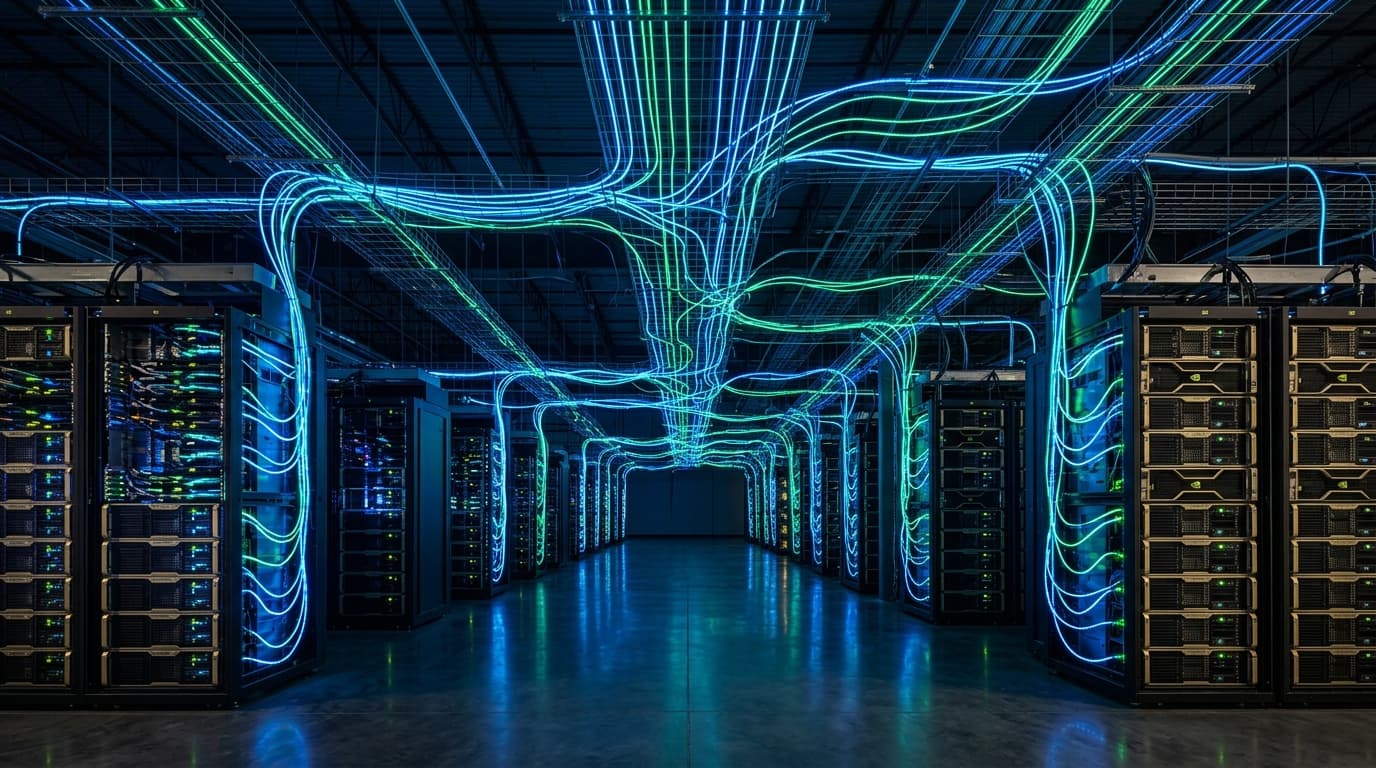
While the world's gaze remains fixed on Nvidia’s H100 and Blackwell GPU chips, another segment within the company has quietly evolved into a juggernaut. According to the latest analysis from TechCrunch, Nvidia’s networking division pulled in a staggering $11 billion in revenue last quarter. This figure is not just a record high; it signals that networking has become the company's second-largest pillar, rivaling its core chip business and surpassing the total market cap of many independent semiconductor giants.
Nvidia CEO Jensen Huang has repeatedly emphasized that modern AI is no longer about individual chips, but about "data center-scale computing." The networking business acts as the "nervous system" that connects thousands of GPUs, allowing them to function as a single, massive computer. As enterprises pivot from training solitary models to deploying vast agentic ecosystems, the demand for high-speed, low-latency connectivity is experiencing explosive growth.
Spectrum-X and InfiniBand: The Keys to Technical Dominance
Nvidia’s dominance in networking is rooted in its strategic acquisition of Mellanox years ago. Today, this business is driven by two core products: InfiniBand and Spectrum-X (Ethernet). InfiniBand remains the gold standard for supercomputers and top-tier AI clusters due to its unparalleled throughput and near-zero latency. However, Nvidia is now aggressively pushing its Spectrum-X Ethernet platform into enterprise data centers, enabling companies using traditional network architectures to deploy AI workloads with high efficiency.
Industry benchmarks suggest that Spectrum-X significantly outperforms conventional Ethernet, particularly in handling the "collective communications" essential for AI training. This vertical integration allows Nvidia to offer a "full-stack solution"—from chips and software libraries to switches and network interface cards (NICs). Customers buying the entire ecosystem from Nvidia are guaranteed optimal performance, creating a powerful lock-in effect.
Market Trends: The Taiwan Connection and Global Interest
Nvidia’s success is vividly reflected in global market data. According to Google Trends, search interest for "Semiconductor" and "Nvidia" in Taiwan remains at a high of 74. This aligns with Taiwan’s role as the primary manufacturing hub for Nvidia’s products through TSMC and a vast supply chain of server assemblers. Companies like Foxconn, Quanta, and Wiwynn are integral to the production of Nvidia’s networking hardware, making the division’s growth a direct economic boon for Taiwan’s electronics sector.
In California, where search interest stands at 46, the conversation is shifting toward the return on investment (ROI) of "AI Infrastructure." Investors are debating whether networking technology will become the next bottleneck for AI expansion as chip supply stabilizes. For now, Nvidia’s foresight in networking has successfully built a formidable moat against competitors.
Competitors and Industry Challenges
Despite Nvidia’s current lead, the competition is mounting. Broadcom and Cisco are championing the Ultra Ethernet Consortium (UEC) standards in an attempt to break Nvidia’s stranglehold on the high-performance networking market. Additionally, as AI computing shifts toward the "edge," demand for more power-efficient and cost-effective networking is rising, providing opportunities for other players to capture market share in specialized niches.
Future Outlook: Connectivity is Power
In 2026, the trend is clear: while compute power is essential, connectivity defines the ceiling of AI performance. The rise of Nvidia’s networking business marks the company’s final transition from a "chip designer" to a "data center computing platform."
As the Blackwell architecture scales, Nvidia’s interconnect technologies, such as NVLink 5.0, will further blur the lines between a single chip and a massive cluster. For any company hoping to challenge Nvidia’s throne, developing a faster chip than the H100 is no longer enough. They must now engineer a neural network of hardware capable of orchestrating hundreds of thousands of chips in perfect harmony. As one analyst put it: "In the world of AI, speed is meaningless without the reach and stability of the network."