

NASA Delays Artemis II Moon Mission as Global Orbital Competition Escalates
Introduction: The Rocky Road to the Moon
On February 23, 2026, NASA announced a disappointing setback for the Artemis program: the Artemis II crewed lunar mission, originally scheduled for March 2026, has been delayed until April. This marks the second major postponement for the mission. While a one-month delay may seem brief in the grand timeline of space exploration, this setback—caused by a "helium flow failure"—underscores the extreme technical challenges and inherent risks of deep-space travel during a period of intensifying global orbital competition.
The Technical Glitch: Helium Circulation Troubles in the SLS
According to a report by Wired (2026), the delay was triggered by a malfunctioning helium flow system within the Space Launch System (SLS) rocket. Helium is a critical component in rocket engineering, used to cool engine parts and maintain pressure within the massive propellant tanks.
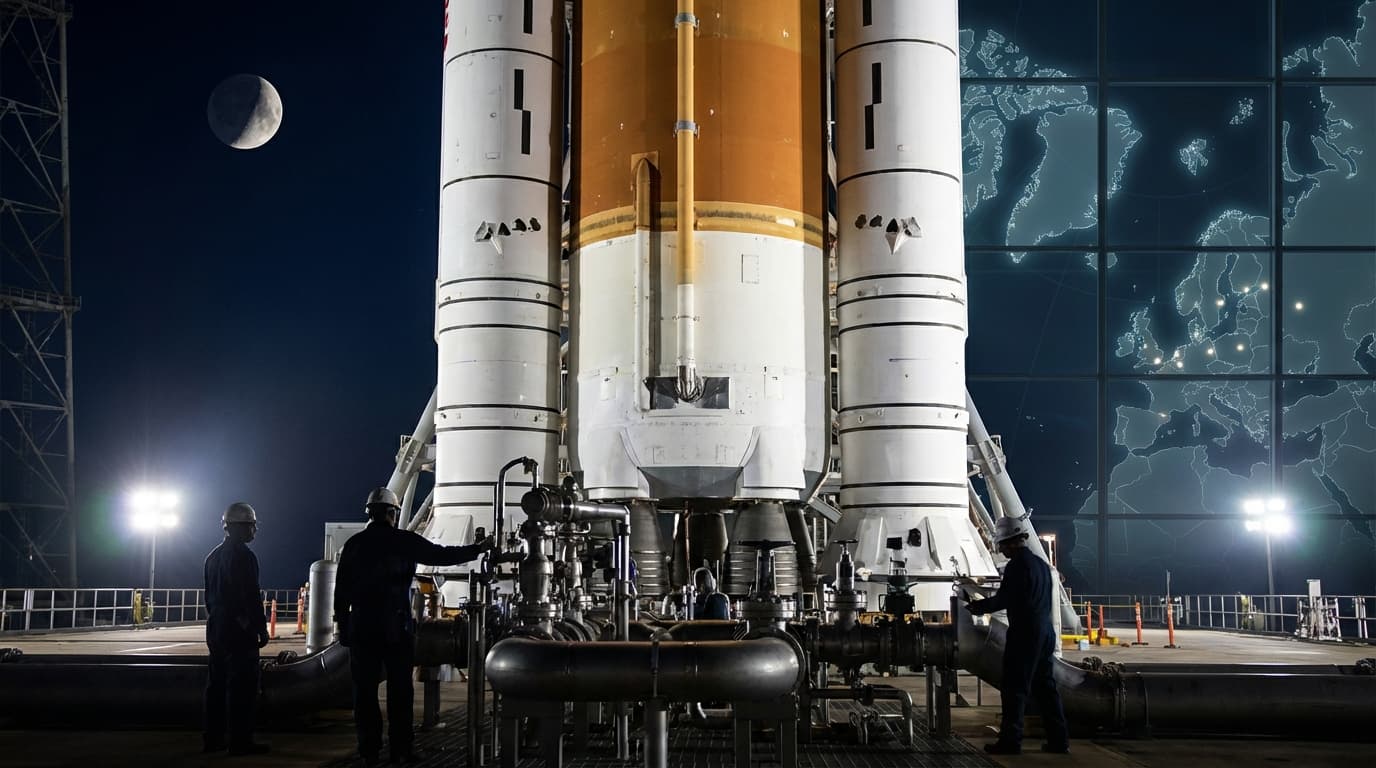
During a recent routine pressure test, engineers detected anomalous flow data in the helium lines. NASA emphasized that failing to address this issue could lead to pressure imbalances during ascent, potentially resulting in a catastrophic failure. Given that Artemis II will carry four astronauts around the Moon, NASA opted for extreme caution, rolling the rocket back for comprehensive repairs.
Global Context: New Space Powers in the Arctic
In contrast to NASA’s delays, Europe is accelerating its efforts to close the gap with the U.S. and China. As reported by BBC Tech (2026), while Europe significantly lags in total orbital launches, it is actively opening new launch facilities in the Arctic Circle to bolster its autonomous space access capabilities.
The heating up of this "Arctic Space Race" reflects a global hunger for resources in Low Earth Orbit (LEO). This ambition is also visible in the commercial sector, with Finnish quantum unicorn IQM planning to go public TechCrunch (2026), showcasing the region's focus on combining quantum communication with space technology.
Expert Analysis: The Payload and Launch Cadence Gap
While the U.S. remains the leader in launch frequency, Pentagon procurement officials have recently sounded the alarm. According to Ars Technica (2026), while the Department of Defense is satisfied with the current commercial launch industry, the development of actual "payloads" (satellites and scientific instruments) is lagging behind.
Experts warn that the delay of Artemis II could have a domino effect on the subsequent Artemis III lunar landing mission, originally planned for 2027. This disconnect between high-frequency launch capacity and slower payload development is a bottleneck shared across the entire space sector.
Environmental and Social Considerations: Rocket Pollution and Data Centers
As humanity reaches for the stars, the environmental cost of the journey is coming under increased scrutiny. A new study highlights that the atmosphere is being polluted by rocket launches more severely than previously thought Ars Technica (2026). This poses a challenge not just for NASA, but for all private space companies.
Furthermore, the terrestrial infrastructure supporting space-age computing is meeting social resistance. In the U.S., farmers are increasingly refusing to sell land to data center developers, even in the face of multi-million dollar offers Ars Technica (2026). This tension highlights the conflict between high-tech expansion and traditional agrarian societies.
Future Outlook: A Lunar Appointment in April 2026
While the postponement of Artemis II is a blow to the timeline, it reflects the "safety-first" ethos of modern astronautics. Following the replacement and re-testing of the helium components, NASA aims to achieve the historic feat of returning humans to lunar orbit in April 2026.
Space enthusiasts should keep a close eye on testing progress throughout March. This "Lunar Marathon" serves as a reminder that space exploration is not just about speed, but about endurance and a profound respect for the unknown risks of the cosmos.
FAQ Section
Q1: Why does a helium glitch cause a whole month's delay? A: The SLS is the most complex rocket ever built. Replacing specialized helium components requires de-stacking or accessing hard-to-reach areas, followed by a full battery of pressure and environmental simulation tests to guarantee astronaut safety.
Q2: What is the main objective of the Artemis II mission? A: It is the first crewed flight of the Artemis program. Four astronauts will travel in the Orion spacecraft to orbit the Moon, testing life-support systems and human performance in deep space.
Q3: Why are new launch sites being built in the Arctic? A: High-latitude sites are ideal for launching satellites into polar orbits, which are essential for global environmental monitoring and persistent communications. These areas also offer vast, sparsely populated zones for safer launches.
Q4: Do rocket launches really pollute the atmosphere significantly? A: Yes. Studies indicate that black carbon and other chemicals from rocket exhaust remain in the stratosphere for long periods, potentially depleting the ozone layer and contributing to subtle climate shifts.
References:
- [src-1] Wired. NASA Delays Launch of Artemis II Lunar Mission Once Again. (2026).
- [src-2] BBC Tech. Orbital space race heats up in Arctic north. (2026).
- [src-3] Ars Technica. Pentagon buyer: We're happy with our launch industry, but payloads are lagging. (2026).