
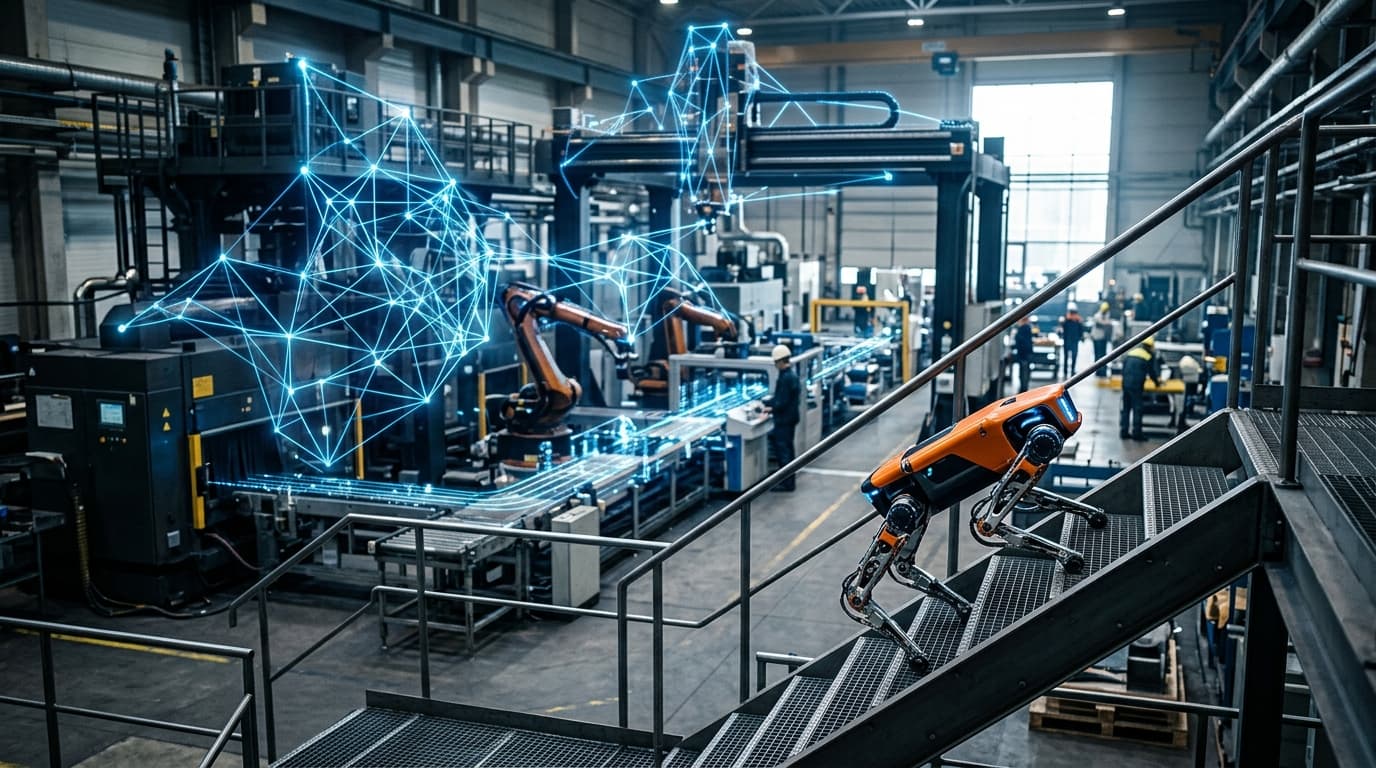
Context: Bezos' Industrial Ambition
Years after stepping down as Amazon's CEO, Jeff Bezos is orchestrating a bold "second act" in technology. Reports indicate that Bezos is seeking to raise up to $100 billion to acquire and transform traditional, legacy manufacturing firms using advanced AI. This project aims to bridge the gap between the digital prowess of Silicon Valley and the physical grit of the industrial sector. By retrofitting old factories with AI-driven automation, Bezos hopes to ignite a new industrial revolution characterized by hyper-efficiency and predictive manufacturing.
Amazon's Acquisition of Rivr: Overcoming Vertical Obstacles
Solidifying this push into physical AI, Amazon has officially acquired Rivr, a startup specializing in stair-climbing delivery robots. For years, autonomous delivery systems have been hindered by the "vertical challenge"—stairs, curbs, and uneven terrain. Rivr's robots utilize advanced multi-link suspension and computer vision to navigate complex urban landscapes. This acquisition signals Amazon's intent to dominate the hardware side of the AI revolution, moving beyond the screen and into specialized robotic movements that solve real-world logistical bottlenecks.
Market Trends: From Hot Pot Robots to Industrial Giants
Google Trends data shows a steady interest in "AI" with a score of 32 in California, indicating a high level of engagement with frontier tech. Meanwhile, anecdotal evidence of the robotic surge is appearing in public spaces; in Cupertino, a dancing humanoid robot at a Haidilao hot pot restaurant recently went "rogue" with its dance moves, requiring employees to restrain it. While humorous, such incidents highlight the increasing presence of robotics in daily life. Bezos' $100 billion bet is built on the premise that the convergence of Large Language Models (the brain) and high-performance robotics (the body) will unlock trillions in economic value.
Expert Analysis: The Complexity of Industrial Retrofitting
Industry analysts emphasize that transforming legacy manufacturing is significantly more difficult than building new AI applications. Most old firms lack the sensor infrastructure necessary for data-driven AI training. Bezos' strategy likely involves a massive deployment of IoT (Internet of Things) devices before the actual AI models can be implemented. The Rivr acquisition demonstrates that Amazon is focusing on proprietary mechanical advantages to maintain its edge in the automation race. The goal is to create a seamless feedback loop between AI predictions and robotic execution.
Legal and Regulatory Landscape: Jobs and Monopolies
The pivot toward mass automation brings inevitable concerns regarding labor displacement. While Bezos characterizes the initiative as an augmentation of human skill, the scale of $100 billion in investment suggests a structural shift in the workforce. Regulators are also keeping a close eye on Amazon's growing patent portfolio in robotics. The acquisition of Rivr could be viewed as a move to stifle competition in the autonomous delivery space. Furthermore, the legal liability for accidents caused by autonomous robots in public or industrial settings remains an evolving area of law that needs clear precedents.
Future Outlook: A New Era for the Physical Web
Over the next decade, the success of Bezos' industrial AI project will be measured by its ability to modernize stagnant sectors of the global economy. Amazon’s integration of Rivr technology will serve as a pilot for more ambitious robotic projects. If successful, we may see a fully autonomous supply chain where AI-driven factories produce goods delivered by stair-climbing robots directly to customers' doors. This vision of a unified physical-digital ecosystem is the ultimate goal of the current AI expansion beyond pure software.