
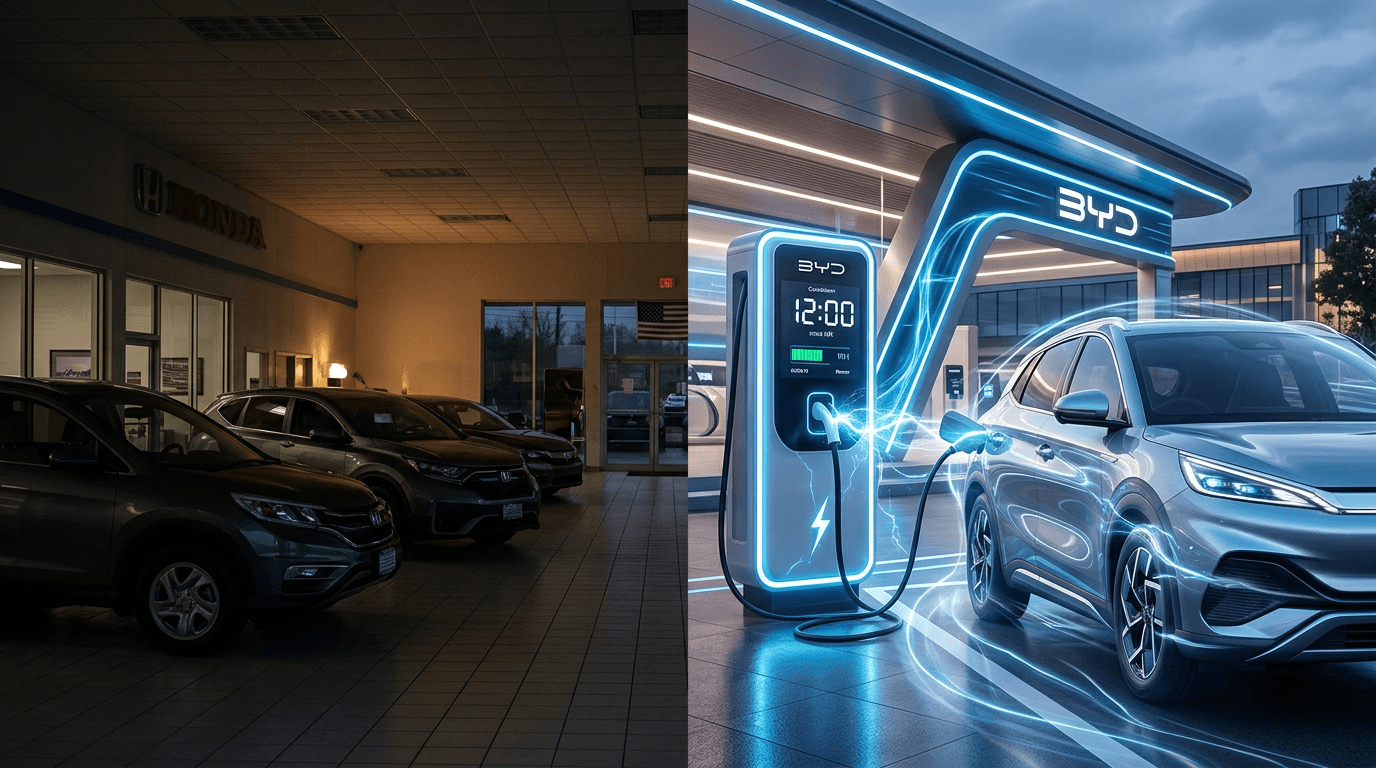
The Reshaping of the EV Landscape: Attack and Retreat
The global electric vehicle (EV) market is undergoing a seismic shift, highlighted by two starkly contrasting developments that reveal the growing technical and strategic divide between legacy automakers and emerging giants. According to TechCrunch, Japanese powerhouse Honda has announced it will discontinue the sale of its three current EV models in the United States, marking a significant strategic retreat from the North American electric market. Simultaneously, Chinese EV leader BYD has announced a major technical breakthrough, achieving a near-full charge in just 12 minutes for its latest models.
Honda's decision sent shockwaves through the automotive world. These three models, including the Prologue and associated sub-brand offerings, were intended to be Honda’s bridge into the electric era and a way to catch up with Tesla. However, plagued by insufficient charging infrastructure, cost inefficiencies, and lukewarm market demand, Honda has decided to cut its losses and reallocate resources toward hybrids and a more competitive next-generation platform. This retreat underscores the "profitability vs. market share" dilemma facing many traditional OEMs.
The Power of 800V Architecture: BYD’s Technical Leap
While Honda retreats, BYD is pressing its advantage. Detailed analysis from Ars Technica explains that BYD’s latest EVs are built on an advanced "800V high-voltage architecture." By doubling the system voltage, this technology drastically reduces heat generation and energy loss during the charging process, enabling the vehicle to reach near-full capacity in a mere 12 minutes. This breakthrough brings EV recharging times tantalizingly close to the time it takes to fill a traditional gasoline tank.
FrontierDaily’s research indicates that 800V architecture is set to become the gold standard for premium EVs. Through the vertical integration of its battery supply chain, BYD has successfully lowered the costs of 800V components while leading the industry in fast-charging protocols and thermal management. Google Trends data shows a significant spike in searches for "BYD fast charging" and "800V architecture" in European and Southeast Asian markets, reflecting a high consumer demand for technologies that resolve "range anxiety."
Market Data Analysis: The Anxiety of Legacy Brands
According to Yahoo Finance, Honda’s stock experienced increased volatility following the announcement of its US EV exit, as investors worry the brand is falling behind in the long-term race toward zero-emission transport. Meanwhile, BYD’s market capitalization continues to rival top-tier global automakers. Data shows that while overall EV sales growth has slowed in the US and Europe, models featuring high-performance fast charging continue to maintain strong growth momentum.
Industry analysts note that Honda’s setback reflects a common struggle among Japanese and European automakers. Without in-house battery R&D and Software-Defined Vehicle (SDV) architectures, relying solely on collaborative partnerships (such as Honda’s deal with GM) has failed to create long-term price competitiveness. Chinese manufacturers, fueled by economies of scale and rapid technical iterations, are building a formidable barrier to entry for their legacy rivals.
Infrastructure and Regulatory Hurdles
Despite the excitement surrounding 12-minute charging, its mass adoption remains tethered to infrastructure. Ars Technica points out that most existing public charging stations are incapable of delivering the ultra-high power output required by 800V systems. Consequently, automakers must not only build efficient cars but also follow Tesla’s lead in investing billions to build their own proprietary charging networks. For companies like Honda, the capital required for such infrastructure has become an insurmountable burden.
Future Outlook: A Winner-Take-All Market?
The EV market is transitioning from a diverse field of competitors to a "winner-take-all" environment. BYD’s fast-charging milestone will further cement its leadership outside North America, while Honda’s retreat serves as a sobering reminder that even legacy giants can be marginalized if they fail to achieve core technical breakthroughs.
The next critical battleground will be the democratization of 800V technology—bringing it to mainstream price points. If BYD or Tesla can achieve this, the survival space for traditional automakers will shrink further. Whether Honda can stage a "comeback" with its next platform will be the most watched narrative in the automotive industry beyond 2026.