
Context: From Disposable Tech to Longevity and Privacy
After a decade characterized by glued-shut chassis and non-replaceable parts, the technology industry is undergoing a significant design pivot in 2026. Driven by global regulatory pressure—most notably from the EU—and the growing "Right to Repair" movement, manufacturers are being forced to prioritize product longevity. In March 2026, tech leaders Apple and Samsung introduced flagship hardware that showcases two new dimensions of innovation: extreme repairability and integrated visual privacy. According to TechCrunch, Apple’s new MacBook Neo has received unprecedented praise from iFixit, marking a new milestone for the company’s hardware philosophy.
Key Developments: MacBook Neo and the Right to Repair Triumph
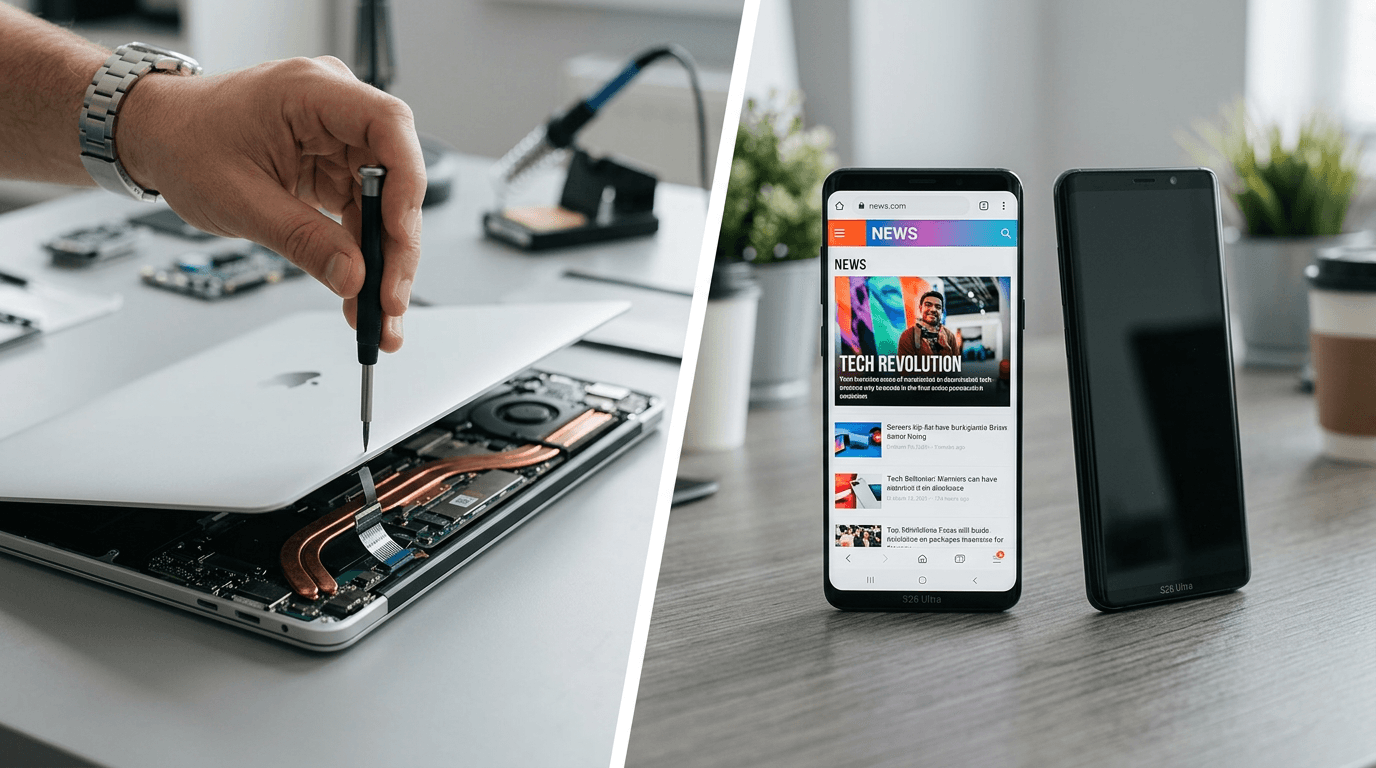
Apple, once a staunch opponent of independent repairs, has fundamentally shifted its approach with the MacBook Neo. According to a detailed teardown by iFixit, the Neo features a modular internal design where key components, including the battery and keyboard, are significantly easier to replace. iFixit hailed it as the "most repairable MacBook in fourteen years." This shift not only lowers the total cost of ownership for consumers but also aligns with Apple’s high-profile environmental commitments. TechCrunch notes that while the Neo is positioned as Apple's most affordable laptop, its design breakthroughs in repairability are arguably its most premium feature.
Privacy as a Feature: Samsung Galaxy S26 Ultra’s Shield
In the smartphone arena, Samsung’s new Galaxy S26 Ultra is seeking differentiation through advanced display technology rather than raw performance metrics. A review by Wired highlights the device’s built-in privacy display. With a simple software toggle, the screen’s viewing angles are constricted, preventing shoulder-surfing in public spaces. While the S26 Ultra’s hardware specs represent an incremental upgrade over its predecessor, this physical solution for digital privacy has resonated strongly with consumers. Wired reports that the technology works exceptionally well without the brightness and clarity trade-offs typically associated with third-party privacy screen protectors.
Ecosystem Synergy: The Strategic Role of Galaxy Buds 4 Pro
Complementing the S26 Ultra is the new Galaxy Buds 4 Pro. According to The Verge, these earbuds feature upgraded woofers and a dual-amped hi-fi sound architecture. While the external design is a subtle refinement, their importance to Samsung’s ecosystem strategy is paramount. The Verge emphasizes that while the Buds 4 Pro are a top-tier choice for Galaxy phone owners, their performance is notably limited on non-Samsung devices. This reflects a broader industry trend where manufacturers use core flagship hardware to attract users and high-quality accessories to lock them into a proprietary ecosystem.
Industry Insight: New Drivers for Hardware Sales
Google Trends data indicates that while the global smartphone market is maturing, search interest for "Refurbished" and "Repair" has seen a significant uptick in 2026. This trend explains why Apple is willing to compromise on traditional design sleekness for repairability—longevity has become a marketable asset as consumers prioritize resale value and sustainability. Simultaneously, as the nomadic workforce grows, privacy has become a non-negotiable requirement, making Samsung’s integrated privacy shield a timely innovation for high-end professionals.
Future Outlook: The Convergence of Sustainability and Security
Looking ahead, the next generation of hardware design will likely move beyond the "thinner and faster" mantra toward a paradigm of "sustainable and secure." It is expected that more laptop manufacturers will adopt the modular architecture seen in the MacBook Neo to comply with upcoming global standards. Meanwhile, Samsung’s privacy display technology could eventually trickle down to mid-range models. The hardware class of 2026 suggests that in an era of software-driven AI, the value of hardware is returning to its physical fundamentals—how long it lasts and how well it protects the user's immediate physical space.