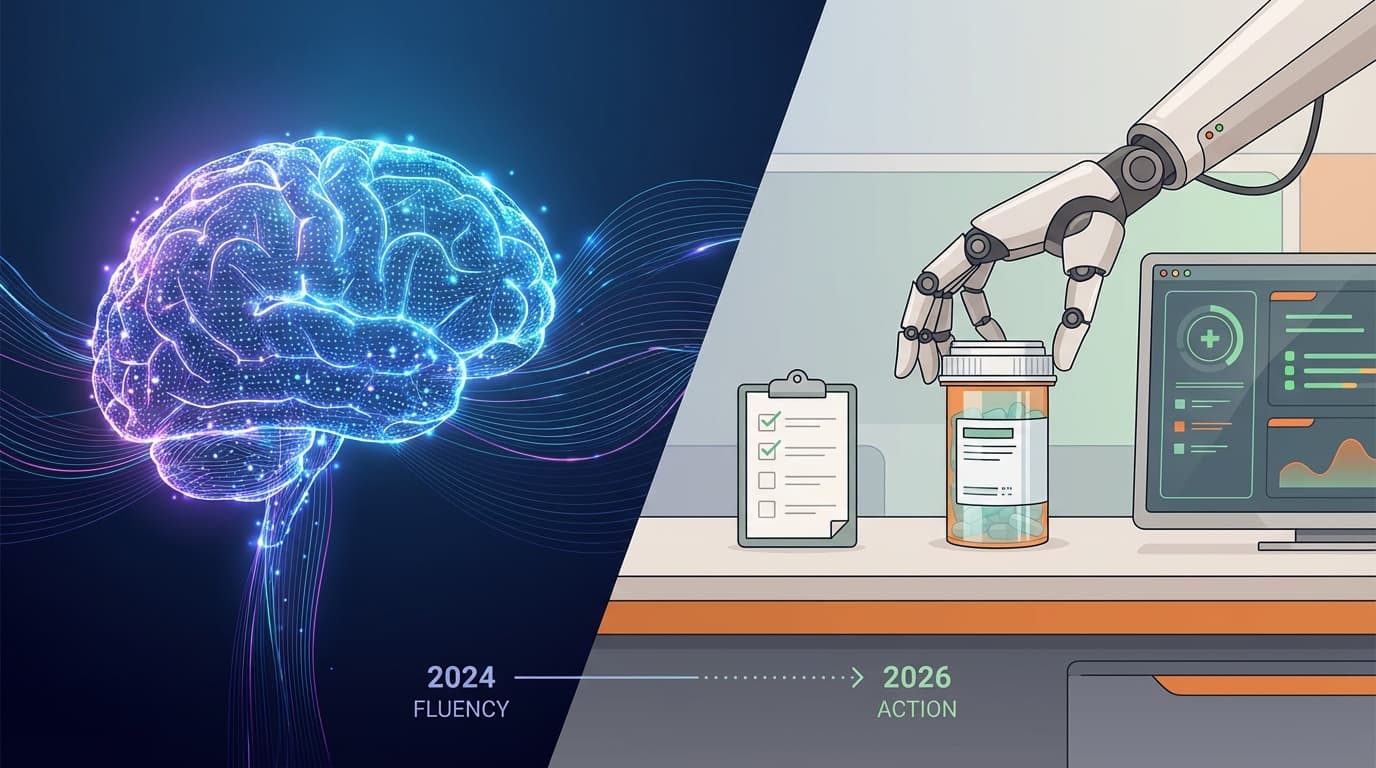
Core Trend: The Rise of Agents and the Return of Verifiability\n\nOn February 20, 2026, the academic frontier shifted decisively toward 'Verifiable Agents'—AI systems that prioritize tool-augmented action over mere text generation. \n\nOpenEarthAgent [1] introduces a unified framework enabling agents to interpret satellite imagery and interact with GIS tools and multispectral indices like NDVI. This addresses the long-standing challenge of maintaining coherent logic across spatial scales. Simultaneously, KLong [49] demonstrates that a 106B parameter agent, trained via 'trajectory-splitting SFT' and 'progressive RL,' can conquer extremely long-horizon research tasks, outperforming trillion-parameter models on benchmarks like PaperBench.\n\n## Medical AI Reality Check: Specialization vs. Generalization\n\nToday's papers reveal a stark contrast in medical AI. On one hand, specialized models are reaching new heights: CNNeoPP [79] leverages LLM-derived sequence representations for superior personalized neoantigen prediction, while EVAD-YOLO [55] achieves 90.4% precision in detecting gastrointestinal lesions in endoscopic videos. \n\nHowever, general-purpose Multimodal LLMs (MLLMs) are facing a 'reality check.' A cross-sectional analysis [57] of ChatGPT, Gemini, and Grok found they failed significantly at calculating Cobb angles from spinal radiographs, with errors so large they rendered the outputs clinically useless. Furthermore, the MediConfusion benchmark [72] reveals that current medical MLLMs are easily confused by visually distinct image pairs, performing below random guessing. This underscores a critical reliability gap that must be bridged before generalist models can be safely deployed in clinical settings.\n\n## Paradigmatic Shifts in AI Foundations\n\nIn terms of architecture and efficiency, Sink-Aware Pruning [2] challenges established theories by proving that attention sinks in Diffusion Language Models (DLMs) are transient and less structurally essential than in autoregressive models. This discovery enables more aggressive and efficient model compression. Meanwhile, AutoNumerics [24] represents a shift in scientific computing; this multi-agent framework autonomously designs and verifies transparent PDE solvers from natural language, moving away from black-box neural approaches toward interpretable numerical analysis.\n\n## Conclusion\n\nThe trends of early 2026 emphasize that AI success is no longer defined by semantic fluency, but by 'Verifiable Action.' Whether it is tool-use in geospatial discovery, the logical integrity of long-horizon tasks, or the visual precision required for medical diagnosis, 'Verifiability' has become the central requirement for the next generation of artificial intelligence.