
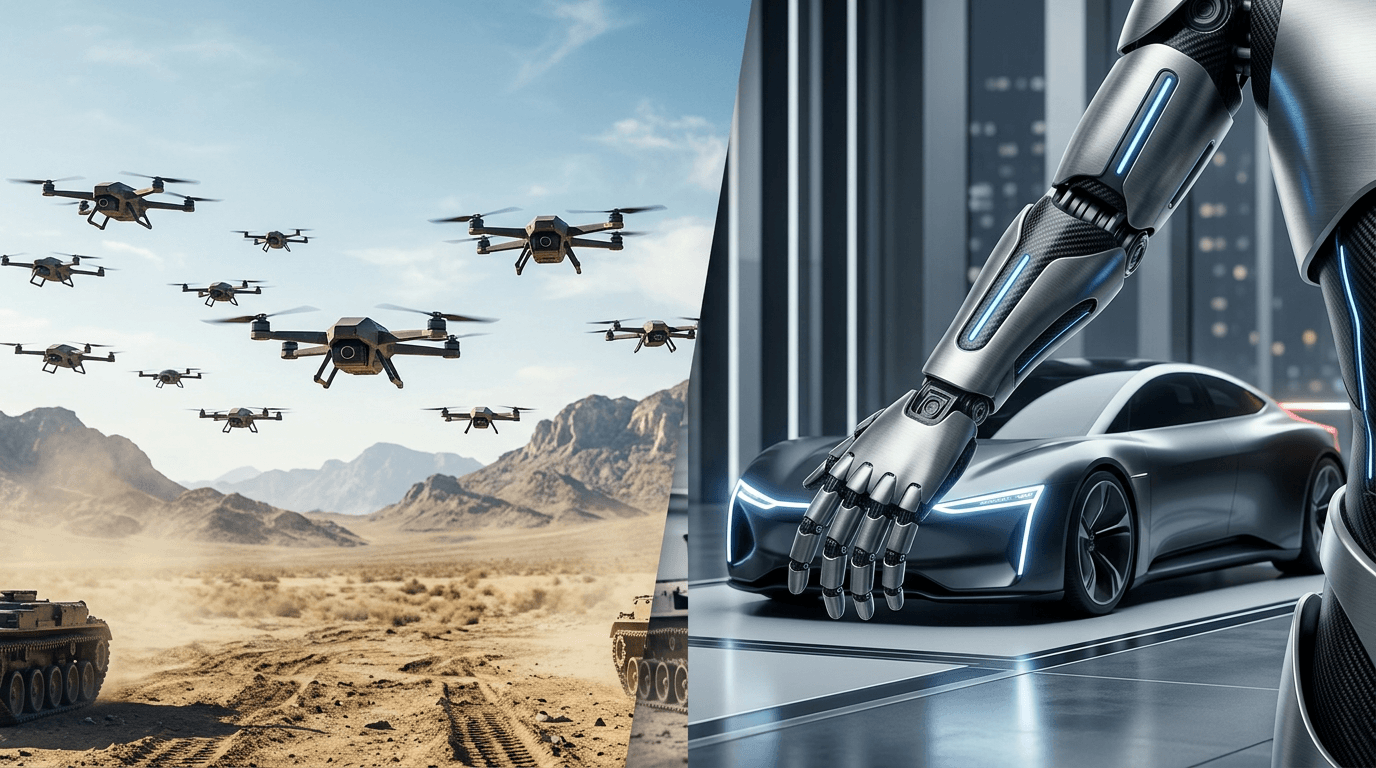
Context: Geopolitical Drivers of Defense and Mobility Transformation
In March 2026, the global technological landscape witnessed two massive shifts: the comprehensive automation and integration of defense technology and a radical reshuffling of the electric vehicle (EV) market. In the defense sector, Anduril Industries, founded by Palmer Luckey, shattered industry records with a colossal new contract. Simultaneously, in the mobility sector, manufacturers Rivian and Honda are charting vastly different paths toward the future. According to TechCrunch, the U.S. Army has announced an enterprise contract with Anduril worth up to $20 billion, signaling that software-defined defense has become the new cornerstone of national security.
Key Developments: Anduril’s $20 Billion Empire and Software-Defined Defense
The contract announced by the U.S. Army is groundbreaking not only for its financial scale but also for its structural innovation. TechCrunch reports that this single enterprise contract consolidates more than 120 separate procurement actions into one cohesive framework. Anduril’s competitive edge lies in its Lattice system, an AI-powered platform that integrates drones, sensors, and command systems. This contract demonstrates the U.S. military’s commitment to unifying fragmented defense technologies into a flexible, efficient system capable of meeting the demands of modern warfare. Anduril’s rise proves that the future battlefield will be dominated by algorithms and autonomous systems rather than traditional heavy hardware.
The Great Mobility Divide: Rivian Toward Robotics, Honda Exits EVs
The civilian transportation sector is experiencing equally dramatic changes. Rivian CEO RJ Scaringe recently shared a bold new vision for robotics, suggesting that the industry’s current approach to robot development is fundamentally flawed. He has launched a new venture called "Mind Robotics," indicating that Rivian may be leveraging its expertise in EV automation and battery technology to expand into broader autonomous robotics. In stark contrast, Honda has sent shockwaves through the market by deciding to kill its three primary EV models for the U.S. market. As reported by TechCrunch, this decision will reverberate far beyond North America, reflecting a strategic retreat by some traditional automakers in the face of infrastructure challenges and intense price competition. Experts warn that Honda may be risking its future competitiveness by exiting the EV race at this critical juncture.
Industry Analysis: The Intersection of Autonomy and Robotics
The technologies powering Anduril’s Lattice system and Rivian’s Mind Robotics reflect a unified trend: the rise of Autonomy. Whether it is a drone on a battlefield or a robot on a factory floor, the core challenge remains the same—enabling machines to perceive and make real-time decisions in complex environments. Google Trends data shows that while interest in "EV" in California remains low (interest score: 4), keywords related to autonomous driving and advanced robotics are seeing a steady climb. This suggests that public focus is shifting from simple "energy switching" (combustion to electric) to a deeper "operational switching" (human-led to autonomous).
Future Outlook: Leaders and Laggards in the Age of Autonomy
Looking ahead through 2026, defense budgets will likely continue to tilt toward Silicon Valley-backed firms like Anduril, challenging the dominance of traditional defense contractors. In the automotive world, Honda’s strategic contraction will leave a massive market vacuum for players like Tesla and BYD. For Rivian, the success of Mind Robotics will determine whether it can successfully transition from a niche automaker into a comprehensive AI and robotics powerhouse. The race to define the autonomous future has entered a high-stakes, multi-billion-dollar sprint.