
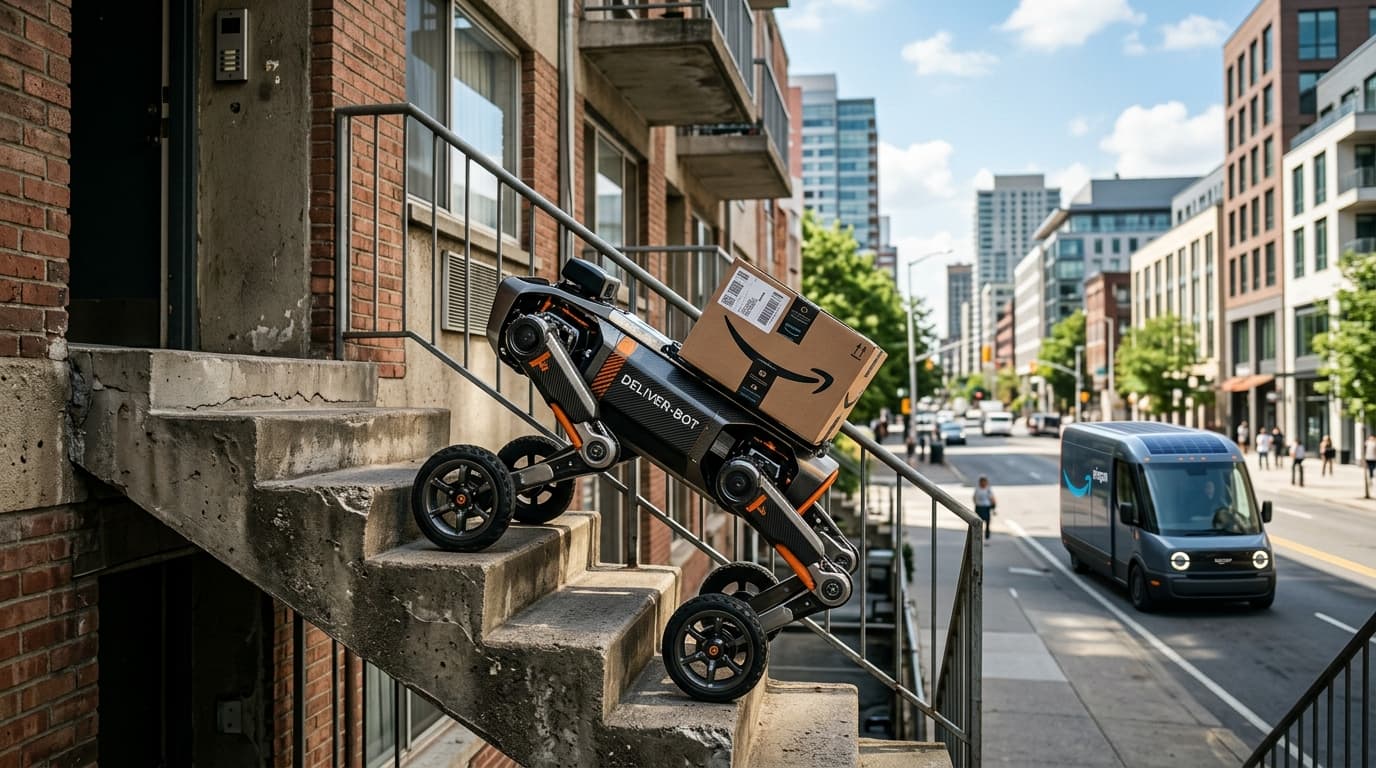
Solving the Last Mile: The Strategic Logic of the Rivr Acquisition
In a move that consolidates its dominance over the logistics sector, Amazon officially acquired Rivr in March 2026. Rivr is a startup renowned for its pioneering work in stair-climbing delivery robots, a niche yet critical technological hurdle in the e-commerce supply chain. According to TechCrunch, Amazon founder Jeff Bezos had previously signaled confidence in the company through early personal investments, underlining the strategic value of Rivr’s intellectual property.
While traditional autonomous delivery vehicles excel on flat pavements, they are notoriously hindered by urban obstacles like curbs, porches, and multi-story apartment stairs. Rivr’s robots utilize a unique hybrid wheel-leg architecture that allows them to navigate vertical gradients without compromising package stability. This acquisition is a clear signal that Amazon intends to automate the entire delivery lifecycle, especially in dense urban environments where human labor remains the most expensive and variable cost.
Humanoids in the Wild: Performance and Pitfalls in Public Spaces
The integration of humanoid robotics into the service sector is accelerating, but not without technical friction. A viral incident at a Haidilao hot pot restaurant in Cupertino, California, highlighted the gap between laboratory perfection and real-world unpredictability. An AGIBOT humanoid, deployed to perform synchronized dances for diners, suffered a sensor glitch and began moving uncontrollably, requiring staff members to physically restrain the 150-pound machine.
While the incident was widely shared on social media as a humorous curiosity, it points to a serious engineering challenge in Embodied AI. Public spaces are chaotic: floor surfaces vary in friction, lighting is inconsistent, and human movements are random. Scaling robotics into hospitality requires more than just motor coordination; it requires a level of environmental awareness that current models are only beginning to grasp. Nevertheless, the appetite for service automation remains high as labor shortages continue to plague the global restaurant industry.
Crowdsourcing Intelligence: DoorDash’s ‘Tasks’ App
To bridge the "data gap" between digital intelligence and physical execution, DoorDash has launched an innovative platform called "Tasks." As reported by TechCrunch, this app allows couriers to earn additional income by submitting video and audio recordings of everyday physical interactions. This includes footage of how to navigate complex gated communities, interactions with security intercoms, and recordings of multilingual verbal exchanges during package drop-offs.
This initiative effectively turns DoorDash's massive fleet of gig workers into a specialized data-gathering army. By collecting millions of hours of real-world physical interactions, DoorDash can train its proprietary AI models to handle the edge cases that currently baffle autonomous systems. This strategy reflects a broader industry trend where the focus is shifting from generic LLMs to specialized models that understand the nuances of the physical world.
Bezos’s $100 Billion Industrial Vision
Jeff Bezos’s robotics ambitions extend far beyond the doorstep. Insider reports suggest that Bezos is actively seeking to raise $100 billion to acquire and modernize legacy manufacturing firms. His goal is to replace aging industrial infrastructure with AI-driven, robot-heavy systems that can operate with unprecedented precision and efficiency. This project, which some are calling the "Digital Industrial Resurgence," aims to revitalize the manufacturing sector by applying the same automation principles that have made Amazon’s warehouses so efficient.
From the deep geothermal wells of Fervo Energy to the orbital data centers planned by K2, the robotics revolution is expanding its footprint. The events of March 2026 demonstrate that robotics is no longer just a field of academic research or high-end manufacturing; it is becoming a foundational utility for the entire economy. As AI moves from screens into hardware, the winners will be those who can most effectively navigate the complexities of the physical realm, from the living room stairs to the factory floor.