

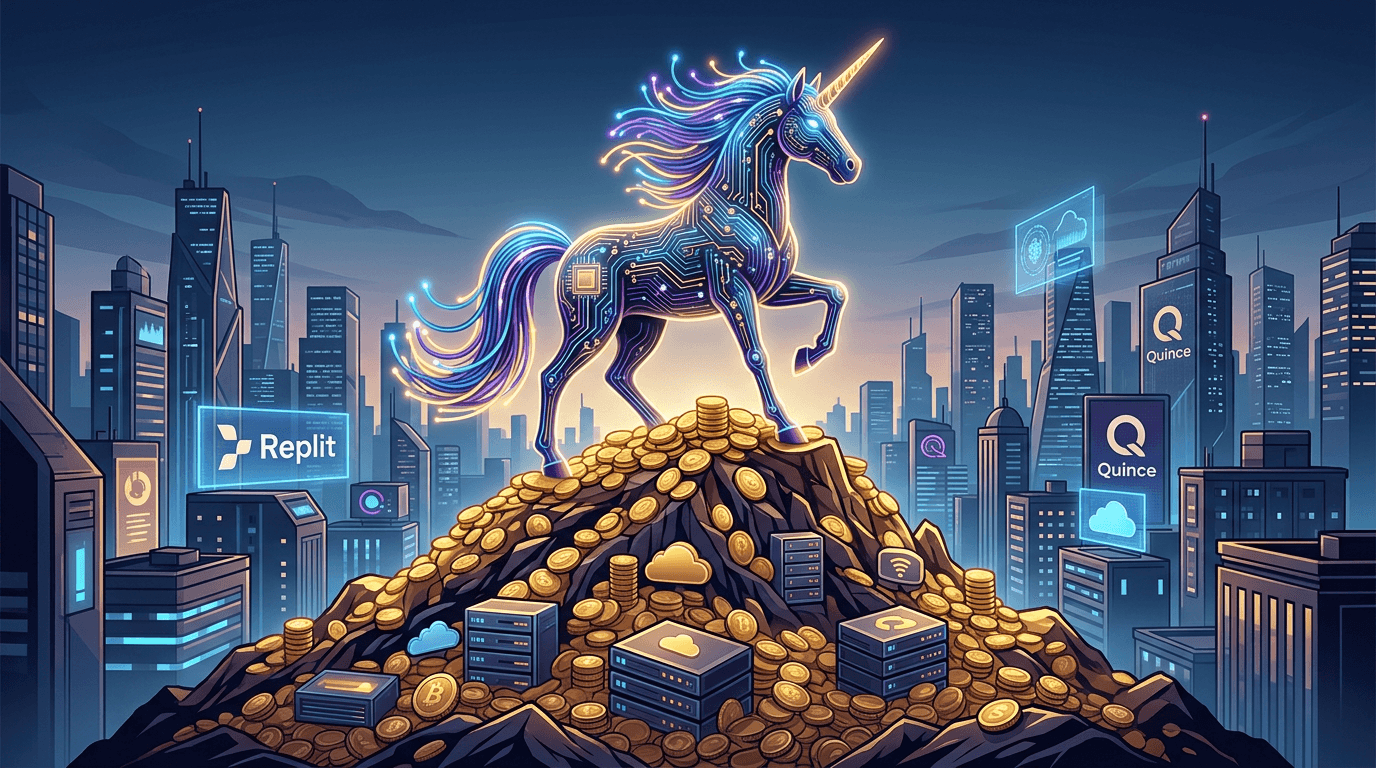
The Rebirth of the Unicorn: AI Drives a Valuation Frenzy
After two years of measured caution and a notable "funding winter," the global venture capital market has roared back to life in 2026 with a velocity that has surprised even seasoned analysts. According to a comprehensive report by TechCrunch, nearly 40 new "unicorns"—private companies valued at over $1 billion—have been minted in the first ten weeks of 2026 alone. This resurgence is driven almost exclusively by the practical commercialization of artificial intelligence, as investors pivot from speculative foundational models to platform companies that are demonstrating massive revenue growth through AI-enabled productivity.
Leading this charge is the collaborative coding platform Replit. In a stunning display of capital momentum, Replit's valuation tripled from $3 billion to $9 billion in just six months following a successful $400 million funding round. The company has set an ambitious target of reaching $1 billion in annual recurring revenue (ARR) by the end of the year. Replit’s success lies in its ability to democratize software development; by integrating advanced AI coding assistants, the platform allows individuals with minimal technical background to build and deploy complex applications. This "productivity multiplier" is exactly what the mid-2026 market is hungry for.
Beyond Software: AI's Impact on Commerce and Consumption
The unicorn boom is not limited to pure-play software companies. Quince, a direct-to-consumer e-commerce platform, recently achieved a $10 billion valuation after a massive $500 million Series E round led by Iconiq. This milestone comes less than a year after its previous capital raise. Quince’s secret weapon is its AI-driven supply chain, which utilizes predictive analytics to connect manufacturers directly with consumers, virtually eliminating waste and drastically reducing costs.
Analysts at TechCrunch point out that Quince’s $10 billion status marks the arrival of the "intelligent retail" era. By using AI to forecast trends and manage inventory at a granular level, Quince offers premium goods at prices that traditional retailers cannot match. Similarly, the beverage industry saw a significant exit with Poppi, a prebiotic soda brand, being acquired by PepsiCo for $1.95 billion. These developments suggest that even in traditional industries, companies that leverage data and modern branding are reaching unicorn levels of success at an accelerated pace.
Following the Money: Mega-Funds and Search Trends
The return of the unicorn is underpinned by the reappearance of "mega-funds." Rumors in the VC community, as reported by TechCrunch, suggest that General Catalyst is raising a staggering $10 billion fund, while Spark Capital is aiming for $3 billion. This concentration of capital indicates that the largest institutional investors are ready to deploy billions into the next phase of the AI revolution. Google Trends data supports this narrative, showing a sharp increase in searches for "AI funding trends" and "new unicorns" in hubs like Silicon Valley, London, and Taipei throughout early 2026.
In Taiwan, the surge in global AI valuations is being tracked with high intensity. While most of the newly minted unicorns are based in the US and Europe, Taiwan's venture capital scene is increasingly looking for local startups that can plug into the global AI ecosystem. The high search interest in Taiwan reflects a desire to move up the value chain—from manufacturing the chips that power AI to developing the applications that generate these multi-billion-dollar valuations. The sentiment is clear: AI is no longer a niche technology; it is the fundamental infrastructure for 21st-century business.
The New Frontier: AI-Powered Scientific Discovery
A particularly exciting subset of this boom is "AI for Science." Breakout Ventures recently closed a $114 million fund specifically targeted at early-stage startups in biology and chemistry that utilize AI to accelerate research. Unlike standard SaaS models, these companies are tackling humanity's most complex challenges, such as drug discovery and sustainable material development. While the gestation period for these firms is longer, the potential for massive societal impact and financial return is attracting a new class of long-term investors.
This shift toward scientific depth is exemplified by the Swedish unicorn Lovable. Known for its "vibe-coding" approach, Lovable managed to add $100 million in revenue in February alone with a lean team of just 146 employees. This level of scaling efficiency—where a small team can generate hundreds of millions in revenue—was unheard of in the pre-AI era. It serves as a blueprint for the modern unicorn: lean, highly automated, and focused on high-value output.
Future Outlook: Sustainability vs. Speculation
While the current valuation surges are undeniably impressive, they have also reignited debates about a potential "AI bubble." Critics point to Replit's 3x valuation jump in six months as a possible sign of irrational exuberance. However, proponents argue that today's AI startups are fundamentally different from the loss-making firms of previous cycles. Many of these new unicorns are already generating hundreds of millions in revenue and show clear paths to profitability.
Looking toward the latter half of 2026, the focus will likely shift to sustainability and execution. Investors will begin to scrutinize whether these companies can maintain their growth rates once the initial hype fades. Nevertheless, the sheer volume of capital being raised and the pace at which new unicorns are being minted suggest that the AI renaissance is just getting started. For entrepreneurs and investors alike, the message of 2026 is clear: the age of the multi-billion dollar AI platform has arrived, and the global technology landscape will never be the same.