
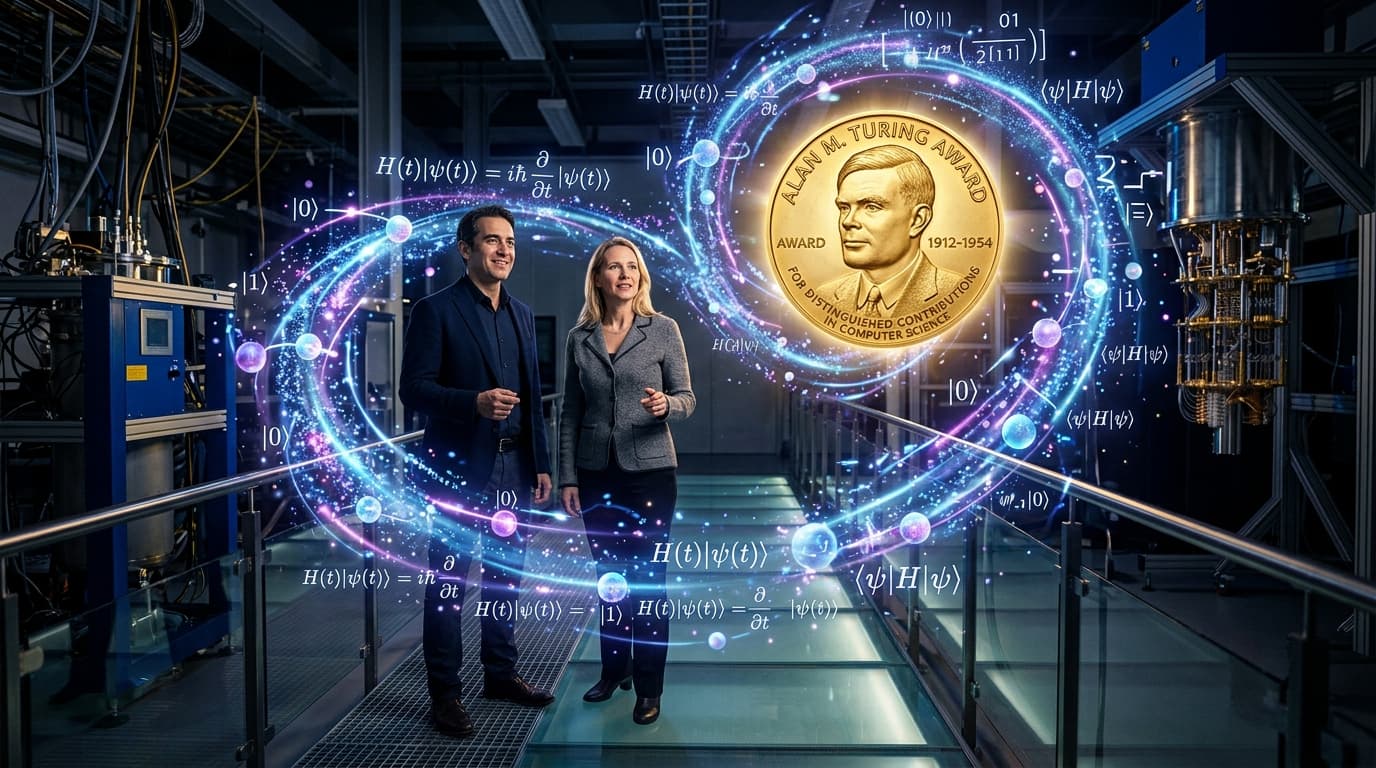
The Highest Honor in Computer Science
The Association for Computing Machinery (ACM) has officially named IBM Fellow Charles Bennett and Université de Montréal Professor Gilles Brassard as the recipients of the 2026 A.M. Turing Award. Often referred to as the "Nobel Prize of Computing," this year's award recognizes their foundational work in quantum information theory—a field that, four decades after its inception, is now sparking a global revolution in processing power and cybersecurity.
As highlighted by WIRED, the duo is best known for developing the BB84 protocol in 1984, the world’s first practical scheme for Quantum Key Distribution (QKD). By leveraging the fundamental laws of physics—specifically the principle that observing a quantum system inevitably alters it—BB84 ensures that any eavesdropping attempt on a communication channel is instantly detectable. In an era where traditional encryption is increasingly threatened by the rise of powerful computers, their work serves as the ultimate safeguard for digital privacy.
From Teleportation to Physical Reality
Beyond cryptography, Bennett and Brassard were also pivotal in co-discovering "Quantum Teleportation." This theoretical breakthrough described how the state of a quantum particle could be transmitted to another distant particle without the physical movement of the matter itself. This concept is the cornerstone of the modern "Quantum Internet," enabling the transfer of information between quantum processors across vast distances.
Recent academic work continues to build upon their legacy. An ArXiv paper from March 2026 (2603.16845) references Hamiltonian simulation and quantum Gibbs states—fields that rely heavily on the mathematical frameworks Bennett and Brassard established in the early days of the field. This demonstrates that their research remains a living, breathing part of today’s most advanced superconducting and photonic quantum computer development.
A Decades-Long Wait for Validation
While their core theories were proposed in the early 1980s, the hardware required to validate them lagged for decades. It is only in recent years, with breakthroughs from labs like IBM, Google, and others in qubit scaling and error correction, that quantum information theory has shifted from abstract mathematics to a tangible engineering challenge. The timing of this Turing Award suggests that the ACM now views quantum computing as having reached a critical mass, moving beyond experimental curiosity to a foundational pillar of computer science.
Shaping the Future of Computational Architecture
Quantum information theory is about more than just raw speed; it fundamentally changes how we approach "complexity." In fields that stymie classical binary computers—such as molecular drug discovery, advanced material science, and climate modeling—quantum algorithms offer a way forward. With the prestige of the Turing Award behind them, the industry expects a surge in funding for quantum error correction and the standardization of quantum network protocols.
Conclusion: A Scientific Dialogue Across Time
The recognition of Charles Bennett and Gilles Brassard is a testament to the power of pure theoretical exploration. In an era before the internet was a household utility, they envisioned a digital world protected by the laws of subatomic physics. Today, as we stand on the precipice of quantum advantage, the global tech community owes a debt of gratitude to these two visionary pioneers.