
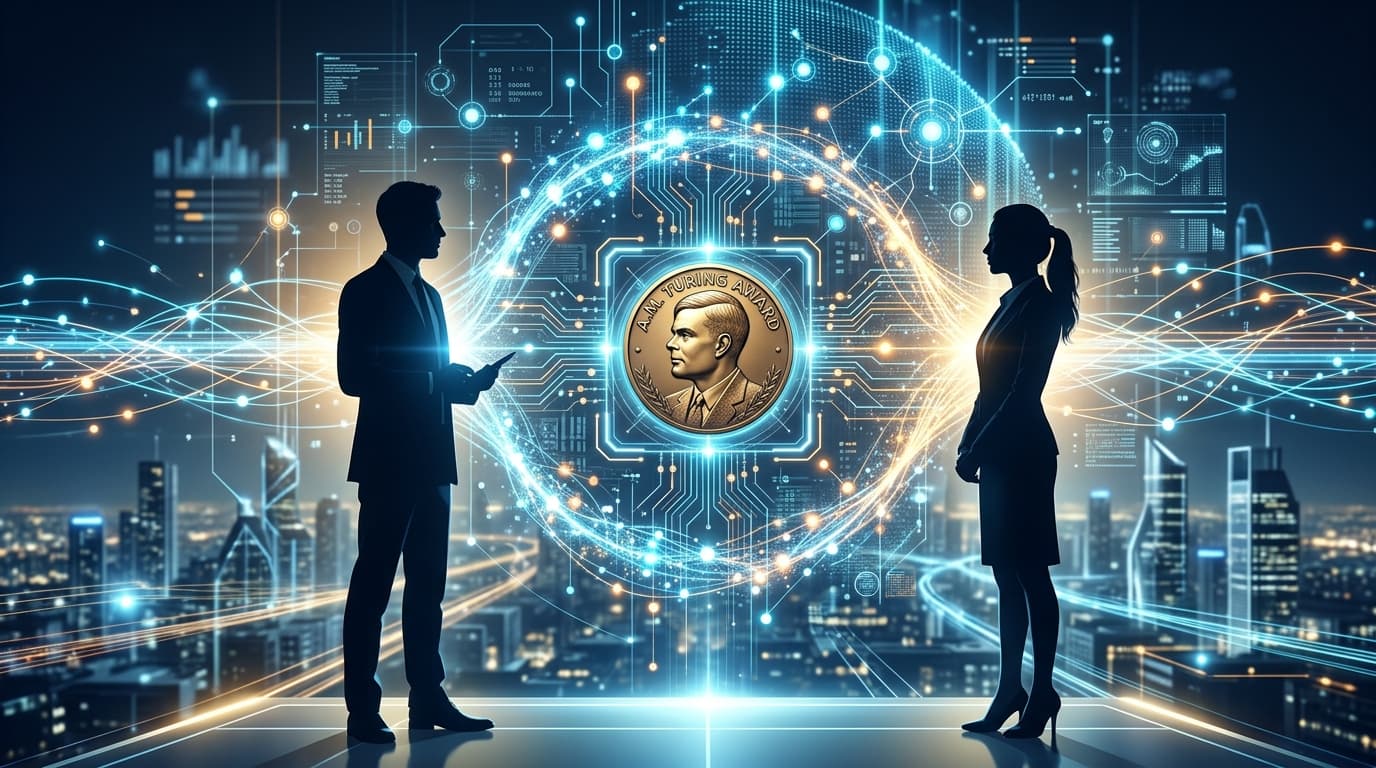
The Nobel Prize of Computing: Honoring the Architects of Quantum Information
The Association for Computing Machinery (ACM) has officially named Charles H. Bennett and Gilles Brassard as the recipients of the 2026 Turing Award. This prestigious honor recognizes their foundational contributions to quantum information theory and quantum cryptography—work that has defined a new scientific discipline and secured the future of digital communications in the quantum era. Often referred to as the "Nobel Prize of Computer Science," this award underscores the computer science community's recognition of quantum technology as the defining frontier of our time.
According to reports from the BBC and Wired, the duo's most celebrated achievement is the creation of the BB84 protocol in 1984. As the world’s first quantum key distribution (QKD) protocol, BB84 leverages the fundamental laws of physics—specifically Heisenberg's Uncertainty Principle—to ensure that any attempt at eavesdropping on a communication channel is instantly detectable. If an interloper tries to observe the quantum signal, the state is altered, alerting the communicators and rendering the data transmission "physically secure."
From Theoretical Curiosity to Global Necessity
While Bennett (of IBM Research) and Brassard (of the University of Montreal) laid their theoretical foundations four decades ago, the urgency of their work has only recently permeated global consciousness. With the rapid advancement of quantum computers capable of shattering existing RSA encryption standards, the search for "quantum-resistant" security has become a paramount global priority. The breakthroughs achieved by these two pioneers are now seen as the ultimate shield against the impending "quantum crisis."
Beyond cryptography, Bennett and Brassard were instrumental in the development of Quantum Teleportation. This revolutionary concept allows the transfer of a quantum state from one particle to another without moving the physical particle itself across the intervening space. This technology is the cornerstone for building a future "Quantum Internet." The Turing Award committee noted that their work transformed quantum phenomena from the realm of science fiction into rigorous mathematical frameworks that can be implemented in laboratories today.
Industrial Impact and Technological Legacy
The announcement has sparked significant excitement throughout the technology sector. Major industry players like Nvidia, Microsoft, and IBM are currently pouring billions into quantum computing and secure communication infrastructure. Google Trends data shows that in Taiwan, a global nexus for semiconductors and advanced telecommunications, search interest for "Quantum Computing" and "Turing Award" reached a peak of 74 today, reflecting intense interest from academia and the private sector.
In California, where search interest hit 46, discussions are focused on the standardization of "Post-Quantum Cryptography." The recognition of these two titans provides a clear validation for the ongoing global upgrade of digital infrastructure. Industry analysts suggest that this award is not just a look back at historical achievements but a definitive roadmap for where the next generation of computing is headed.
Challenges and the Horizon of Quantum Security
Although the theories established by Bennett and Brassard are flawless, the engineering reality of mass implementation remains challenging. Issues such as signal loss in fiber optics, the development of reliable quantum repeaters, and the reduction of the cost and size of QKD hardware are still being addressed. Nevertheless, the technology is already finding early applications in high-security sectors like finance, defense, and government communications.
Looking forward, we are at the precipice of the most significant shift in communication history. As Bennett noted in his acceptance speech, "We are learning to think not just in bits, but in qubits, to understand our world." The revolution sparked by these two visionaries will ultimately redefine how we protect our data, transmit our ideas, and interpret the nature of reality itself.